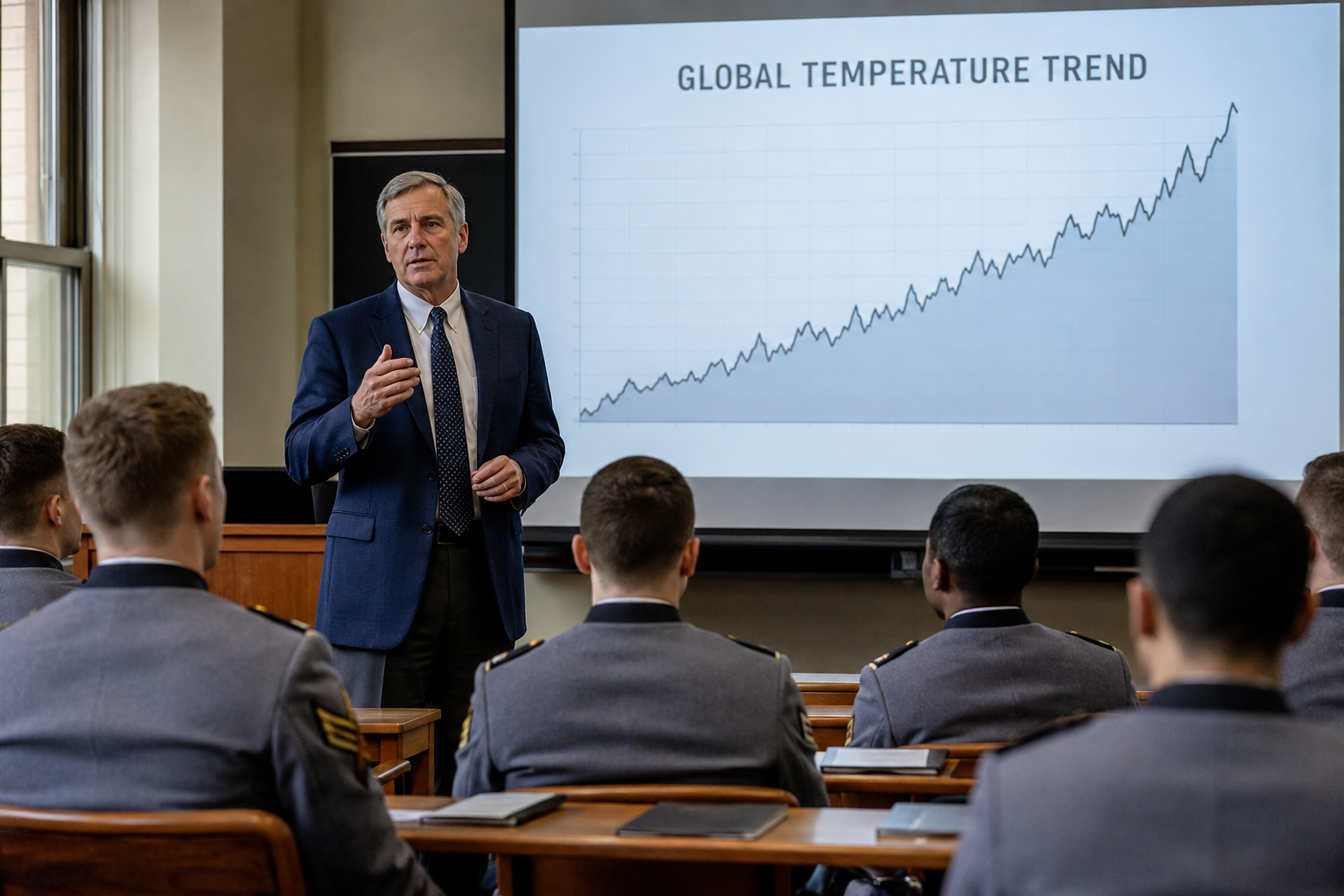
A climate scientist who spent 17 years teaching future Army officers at the U.S. Military Academy at West Point has sued the academy, saying he was pushed out after objecting to an order that faculty stop teaching cadets that humans cause climate change. Adam Kalkstein filed the complaint this week in the U.S. District Court for the Southern District of New York, naming the academy and three members of its leadership.
The Order That Was Never Written Down
The directive came at a September 2025 meeting of West Point’s geography program, according to the lawsuit. Faculty were told to remove all mention of human causes of climate change from their courses. They were also warned that if anyone took the matter to the press or to politicians, the entire department would likely be dissolved.
Kalkstein’s attorney, Michael Sussman, says his client asked repeatedly for the policy in writing and never received it. The closest thing to documentation, Sussman said, was a presentation a colleague later prepared to show academy leadership that the department was complying.
He Followed the Rule, Then Said It Out Loud
Kalkstein complied. The lawsuit describes him physically covering the word “anthropogenic” on figures taken from scientific articles before showing them to cadets. He stayed in part out of concern for the colleagues who would have to absorb his courses if he walked away.
He did not stay quiet inside the chain of command. He raised objections with the academy’s inspector general and its legal office. An attempt to bring his concerns to the dean was blocked by his department head.
His opening came on November 5, 2025, at a geography department meeting with then-Dean Brig. Gen. Shane Reeves. After a colleague presented a slide deck outlining the department’s compliance, Kalkstein read a prepared statement.
“I just got out of climatology class, and it’s a struggle,” he said. “It’s not a college-level course. It’s not even a high school course. Not because it isn’t rigorous; it is. But because we’re leaving out essential information. We’re only telling cadets part of the story. We’re lying to them, deceiving them.” He compared it to teaching law without being able to even mention the Constitution.
According to the suit, Reeves reminded him that the commander in chief sets the agenda at West Point, suggested he resign, then stormed out of the meeting, again warning the department about the consequences of non-compliance. Reeves is now president of the University of Wyoming; a spokesperson there referred questions to West Point.
“Poor Character and Temperament”
At the end of the spring semester, Kalkstein was told his contract would not be renewed past December 2026. The stated justification was “poor character and temperament,” with the November meeting cited as the evidence. He says his file holds 17 years of outstanding evaluations.
His position had already been under pressure. In May 2025 his tenured job was eliminated in a reduction in force, and he was one of two civilian professors cut. That summer the academy agreed to keep him on as a “term employee” paid out of his own grant money. He gave up tenure in October 2025 and forfeited a large severance package. At the time he held a roughly $750,000 external grant researching how weather systems can help protect troops. About 20 percent of West Point’s 500 faculty members are civilians.
A Letter That Never Left Campus
Days after the September order, Kalkstein wrote to Defense Secretary Pete Hegseth. The letter never cleared the chain of command.
Its contents complicate any simple political reading of the case. Kalkstein criticized the previous administration for taking “exaggerated positions” that politicized climate science, and noted that research does not support claims that climate change is the single biggest or existential threat facing every nation. He then argued the subject still belongs in a military classroom.
Human-induced climate change, he wrote, has a “very real, very measurable and very important impact on national security.” He put the practical question plainly: “How can our country compete with the Russians in the Arctic if we ignore what’s causing the present-day melting?” He closed by urging Hegseth to reconsider the order “for the sake of our remarkable students and our wonderful military institutions.”
Sussman describes his client as a conservative man with no ideological agenda. “There are certainly people who, anything Donald Trump does, they want to complain about it and scream and yell about it. He’s not that guy,” Sussman said. “He’s a person who has a great deal of dedication to West Point and the cadets.”
What West Point Says, and What Comes Next
West Point said its officials are “aware of the allegations and take such matters seriously,” and had nothing further to add.
The lawsuit asks for a jury trial, reinstatement of Kalkstein’s tenured position, monetary damages, and an order blocking what it calls “baseless” restrictions on academic freedom.
It is the second faculty speech case against the academy in a year. Law professor Tim Bakken sued in September 2025 over banned books and courses, and in May won an injunction against rules requiring faculty to get leadership approval before publishing papers or speaking at conferences. The government did not contest that ruling.
The backdrop is an administration that has moved aggressively against climate policy. President Trump told the U.N. General Assembly in September 2025 that climate change is “the greatest con job ever perpetrated by the world.”
What This Means for Americans
Most people will never sit in a West Point classroom. But the question underneath this case is one any parent or taxpayer can follow: who decides what future Army officers are allowed to learn, and does a change that significant get made in writing or in a meeting no one records? A federal court will now weigh whether a professor’s objection was misconduct or protected speech.
Stay informed on the stories that matter most. Follow Palmedia News on Facebook and bookmark palmedianews.com for breaking news and analysis.