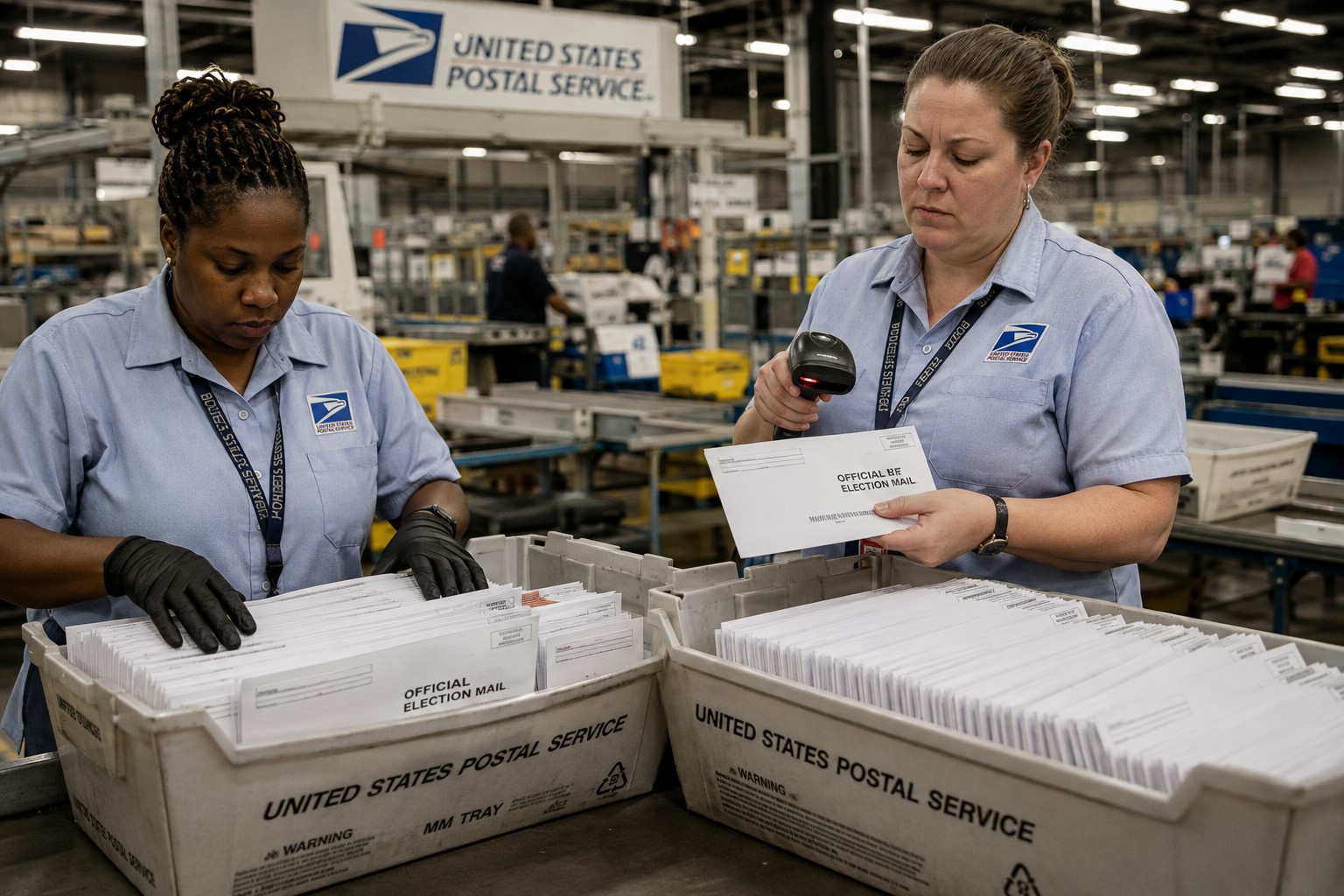
The U.S. Postal Service has confirmed that its new rules for mail-in ballots are in effect, and they land just weeks before the November midterm elections. The 95-page rule was published in the Federal Register on August 26, 2026, carrying an effective date of August 21. It was written to carry out an executive order President Donald Trump signed on March 31 covering mail voting.
For months the regulation sat on the shelf while courts weighed challenges to it. That changed in the space of three days.
Why This Rule Exists
The March 31 executive order directed the federal government to tighten oversight of ballots moving through the mail, arguing that a national tracking and verification standard was overdue. The Postal Service spent the following months drafting the regulation that would put that order into practice, then issued it as a final rule.
Mail voting has grown into a central part of how Americans cast ballots. Tens of millions of voters now receive and return ballots by mail in a federal election year, which means the Postal Service sits in the middle of the process — and any change to how it handles that mail carries consequences for election offices in every state.
What the Rule Actually Requires
The regulation changes the mechanics of ballot mail in three concrete ways.
First, election officials must submit each mail voter’s name and address to a new Federal Ballot Mail Portal. That creates a federal record tied to the individual voters a state is sending ballots to.
Second, every envelope used to send a ballot out, and every envelope used to send it back, must carry a unique Intelligent Mail barcode. The barcode is what allows a specific ballot to be tracked through the postal network rather than treated as ordinary mail.
Third, postal employees are required to verify that outbound federal ballot mail meets the new envelope, barcode and data-reporting standards before they will accept it from a local election office. That verification step is the enforcement mechanism: mail that does not comply can be turned away at the counter.
The Court Fight That Unlocked It
The Postal Service had said it would not apply any of the rule to the 2026 elections unless the court orders blocking it were lifted. Two injunctions stood in the way.
On August 24, the Supreme Court allowed the administration to move ahead with parts of the executive order. Two days later, on August 26, a federal judge lifted the final injunction. With both barriers gone, the condition the Postal Service had set was met, and the rule became operative for the midterm cycle.
The litigation is not over. Democratic-led states filed a new lawsuit, and voting rights groups amended their existing complaint to target the finalized regulation. That makes three separate legal challenges now aimed at the rule, any of which could alter the picture before November.
Reactions and Implications
Supporters describe the rule as an overdue chain-of-custody standard. Their argument is that ballots are among the most consequential items the Postal Service handles, and that barcoding and verifying them brings ballot mail up to the tracking standard already applied to other secure mail.
Opponents raise two objections. The first is about data: routing voter names and addresses into a federal portal centralizes information that has traditionally been held by states and counties. The second is about timing. Election offices now have a matter of weeks to redesign envelopes, generate compliant barcodes and stand up data reporting before ballots go out. Critics argue that a compressed compliance window, combined with a Postal Service that can decline noncompliant ballot mail, creates real risk of disruption.
What This Means for Americans
For most voters, the visible experience of voting by mail should not change. You still request a ballot, receive it, fill it out and send it back. What changes sits behind the counter — the envelope your ballot arrives in, the barcode printed on it, and the data your county submits before it can be mailed.
The practical advice is unchanged and worth repeating: request your ballot early, return it early, and use your state’s tracking tool to confirm it was received. If local election offices hit friction adapting to the new standards, the voters with the most cushion will be the ones who did not wait until the deadline.
Election offices in every state are now working through the requirements with the November calendar running. How smoothly that goes, and whether the courts intervene again, will determine how much any of this is felt at the mailbox.
Stay Informed
Stay informed on the stories that matter most. Follow Palmedia News on Facebook and bookmark palmedianews.com for breaking news and analysis.