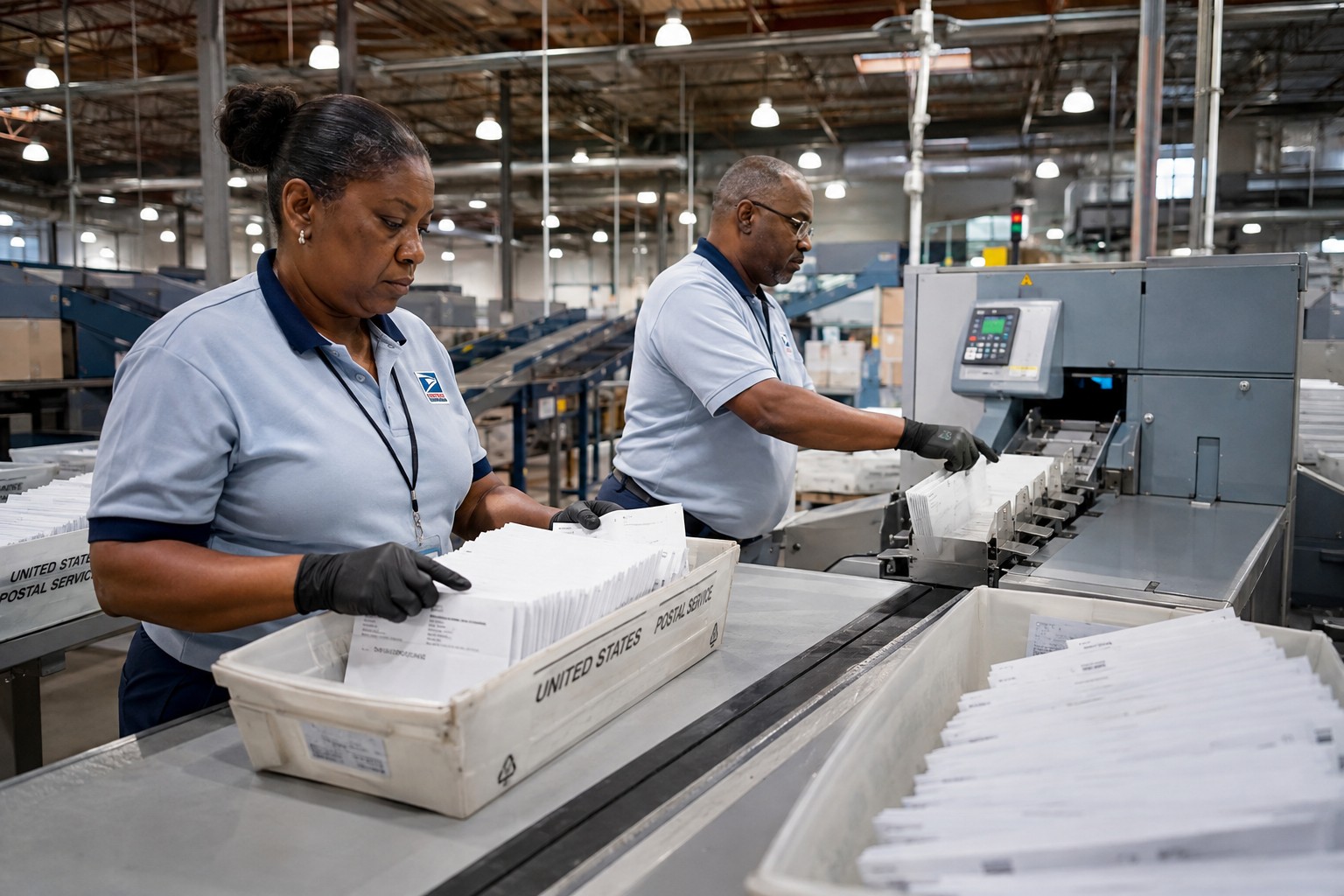
The U.S. Postal Service has finalized a new rule governing how ballots move through the mail in federal elections. It is scheduled to publish in the Federal Register on Aug. 26, 2026, under 39 CFR Part 111. But it is not going into effect for the November election, because federal courts have it blocked.
What the Rule Actually Requires
The first thing to understand is who the rule applies to. It does not create new steps for individual voters. It sets requirements for state and local election officials who mail ballots for federal general, special and runoff elections.
Those officials would have to use ballot envelopes that are compatible with postal automation equipment, print the Official Election Mail logo on them, and place a unique Intelligent Mail barcode on both the outgoing envelope and the return envelope. The barcode is the tracking anchor for everything else in the rule.
The larger change is a new system the Postal Service calls the federal ballot mail portal. Before a ballot mailing enters the mail stream, election officials would upload basic voter information tied to that ballot barcode: a name and a home address. Officials would also have to register their authorized portal users at least two business days before presenting a mailing, and certify that the envelope designs were reviewed.
The Postal Service has drawn explicit limits around what the portal holds. It says no birthdates, no Social Security numbers and no voter registration records go into the system. It also says it will play no role in determining voter eligibility, maintaining voter rolls, or counting ballots.
The rule does carry an enforcement provision. USPS said it would not deliver ballots for states that are not in compliance with the new requirements.
Why None of It Is Live
The rule is finalized on paper, but its rollout is frozen. U.S. District Judge Indira Talwani blocked the ballot-mail provisions in June for 23 states and the District of Columbia. A federal appeals court upheld that order in July. On Aug. 11, Talwani issued a nationwide preliminary injunction covering the Nov. 3 election and any earlier federal election.
The Postal Service acknowledges this directly in the rule itself. It states that it will not implement the regulations for the 2026 election unless the government first obtains relief from the courts. In other words, the framework is built, but the switch stays off while the litigation continues.
The Debate Around It
USPS said it received more than 200,000 public comments on the proposal. The volume alone signals how closely this is being watched.
Supporters describe the barcodes and the tracking requirements as a long-overdue visibility upgrade for ballots moving through the mail, arguing that better tracking makes it easier to spot and investigate problems in transit. The Postal Service made a version of that argument in the rule, saying enhanced visibility would help identify issues that might otherwise go undetected.
Critics focus on the portal rather than the barcodes. Their argument is structural: routing voter names and home addresses into a federal system shifts information, and with it a measure of control, over an election process the Constitution leaves largely to the states. Jonathan Diaz, director of voting advocacy at the nonpartisan Campaign Legal Center, has raised concerns about consolidating that kind of information in federal hands.
It is also worth being precise about what the rule is not. It is not a ban on mail-in voting, and it does not restrict who may vote by mail.
What This Means for Americans
For voters casting a ballot this November, the practical answer right now is: nothing changes. The injunctions mean the requirements will not apply to the Nov. 3 election unless a court lifts them first. If that happens later, the work would fall on election offices, not on individuals, though the administrative burden on smaller county offices, and the timeline they would have to meet, is a live question for anyone who depends on the mail to vote.
Stay informed on the stories that matter most. Follow Palmedia News on Facebook and bookmark palmedianews.com for breaking news and analysis.