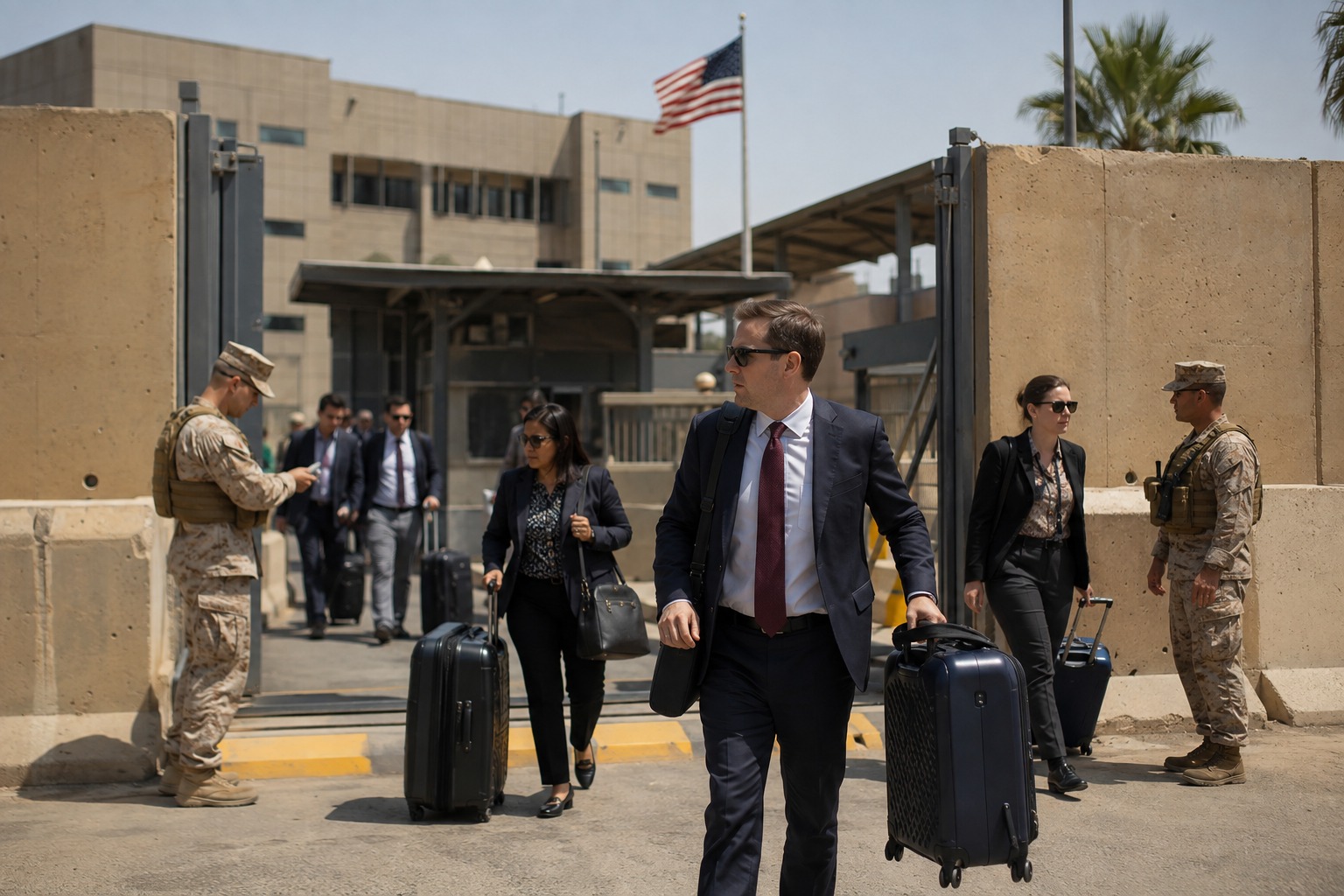
The United States is sending its diplomats back into Middle East embassies that were emptied out before and during the war with Iran. Foreign Service officers could begin returning to their posts as early as this week, according to reporting on the State Department’s redeployment plan.
The return spans a wide stretch of the region. Israel, Jordan, Lebanon, Saudi Arabia, Iraq, Kuwait and Oman are all expected to have staff reinstated after months of reduced operations, skeleton crews and, at several posts, near-total evacuation.
Why The Embassies Emptied
When the fighting with Iran escalated, Washington moved fast to pull non-essential personnel out of harm’s way. Embassies across the region drew down to minimum staffing. Some suspended routine consular services entirely. Ordered departures and authorized departures emptied out entire diplomatic missions, leaving behind only the personnel considered essential to keep the doors open.
That kind of drawdown is not a small administrative step. An embassy running on a skeleton crew cannot process visas at normal speed, cannot support American citizens abroad the way a fully staffed post can, and cannot do the day-to-day diplomatic work that keeps channels open between governments. For months, the American diplomatic presence across a critical region was operating at a fraction of its normal capacity.
What The Return Signals
The timing carries a message. Washington does not move diplomats back into a region it expects to become a war zone again within weeks. The decision signals that the administration does not anticipate an immediate resumption of full-scale fighting.
But nothing has actually been resolved with Tehran. The core disputes between the two governments remain wide open. The easing of restrictions on embassy personnel is not a peace agreement and it is not a settlement — it is a calculated bet that the current calm will hold long enough to restore normal diplomatic operations.
Officials have not indicated that every embassy will snap back to full operations at once. Several posts are expected to reopen in stages, with security assessments driving the pace at each individual location. A mission in one capital may be fully staffed within days while another stays limited for weeks.
The Limits Of The Move
A former deputy assistant secretary of state made the boundaries of the decision clear: bringing embassy staff back to their posts does not tie Washington’s hands when it comes to future action against Iran. Returning diplomats is a diplomatic and logistical judgment about present conditions on the ground — not a commitment about what happens next.
That distinction matters. Embassy staffing levels are often read as a barometer of how a government rates the risk in a region. A return to normal staffing reads as confidence. It does not read as a treaty, and history is full of examples where diplomatic posts reopened only to draw down again when conditions shifted.
What This Means For Americans
For Americans with a direct stake in the region, the practical effects are immediate. Restored embassy staffing means consular services move closer to normal — passport help, emergency assistance for citizens abroad, and visa processing that has been backed up for months. Americans living, working or traveling across these seven countries regain a functioning place to turn when something goes wrong.
There is a broader effect too. Staffed embassies are how governments talk to each other in the ordinary, unglamorous ways that keep small problems from becoming large ones. When those channels go dark, misunderstandings compound. Restoring them lowers the odds that the next flashpoint escalates simply because no one was there to pick up the phone.
The diplomats are going back. The underlying standoff with Tehran is not going away.
Stay informed on the stories that matter most. Follow Palmedia News on Facebook and bookmark palmedianews.com for breaking news and analysis.