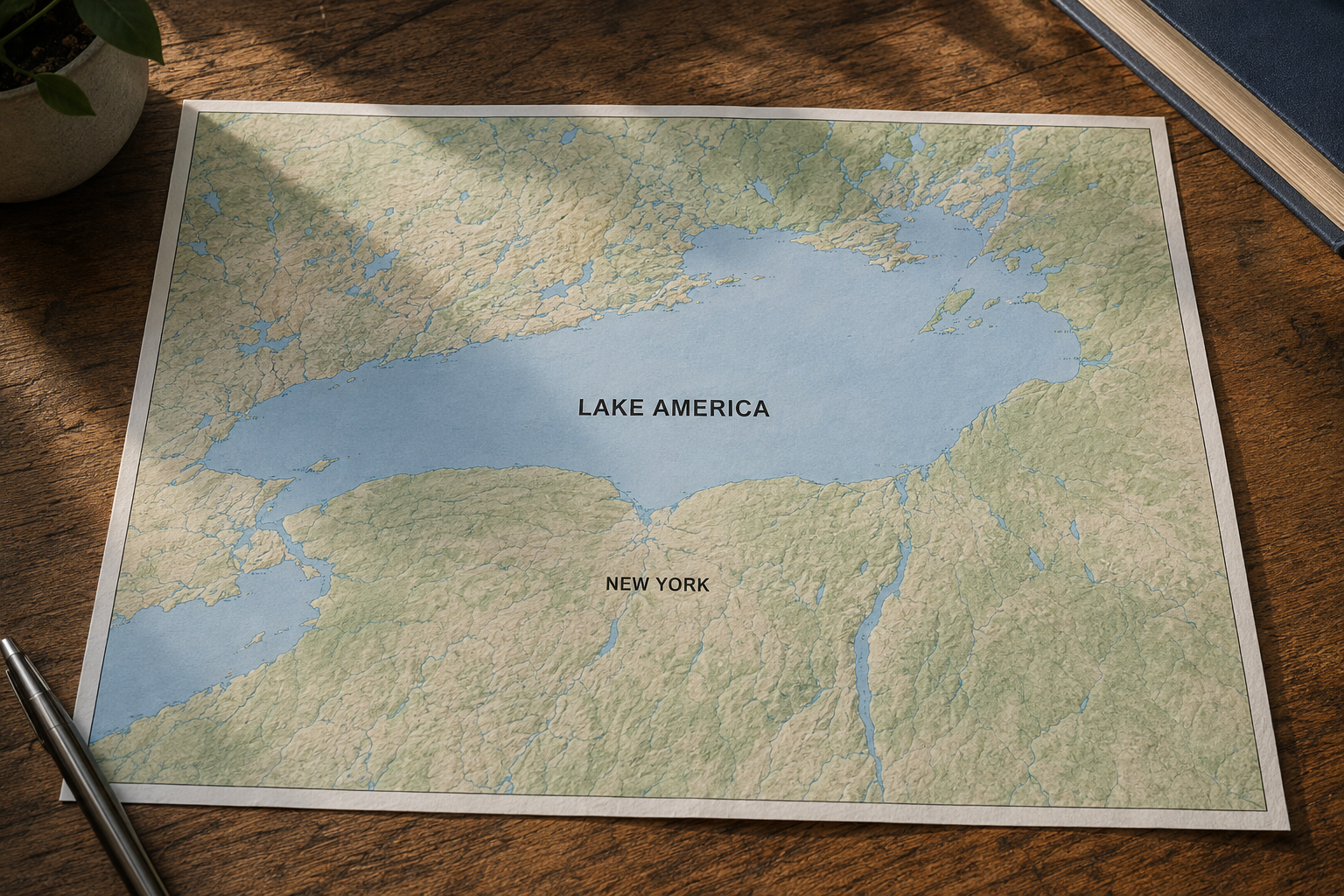
President Donald Trump signed an executive order Thursday changing the name of Lake Ontario to “Lake America,” directing the federal government to adopt the new name across its maps and records. Speaking in the Oval Office after signing it, he called the change official and effective immediately. The order lands in the middle of an escalating trade dispute between the United States and Canada.
What the order actually does
The order instructs the Department of the Interior, led by Secretary Doug Burgum, to update the Geographic Names Information System — the federal government’s official database of place names — to reflect “Lake America” within 30 days. That database is what federal agencies rely on when they print maps, write reports, and label geographic features. Once it is updated, the new name becomes the standard across the federal government.
That is a real and immediate change. It is also a bounded one. The order governs what the United States government calls the lake. It does not, and cannot, compel anyone else to do the same.
Why Lake Ontario is a different case
Lake Ontario is not an American lake. It is a shared one. The international boundary runs through the middle of it, with New York State along the southern shore and the Canadian province of Ontario along the northern. Roughly half the surface sits on the Canadian side.
Naming a shared body of water is not something one country settles by itself. International naming is handled through bilateral agreement and through bodies such as the United Nations Group of Experts on Geographical Names. Canada is under no obligation to adopt the American name, and it has given no indication that it intends to.
The Gulf of America precedent
There is a clear template for what happens next, because a version of this has already played out.
In 2025, Trump signed a similar order renaming the Gulf of Mexico the “Gulf of America.” The Interior Department complied and updated its records. Google and Apple adopted the new name for users inside the United States. Nearly every other country, and most international bodies, kept the original name.
The result was one body of water carrying two names, depending on where you happened to be when you opened the map. The most likely outcome here is the same: American federal documents and American map apps read “Lake America,” while Canadian and international maps continue to read “Lake Ontario.”
The Canada context
The timing is not incidental. The order comes during a sharp deterioration in relations between Washington and Ottawa over trade. Trump had floated the idea publicly days earlier, saying the United States was giving it serious consideration and that he did not expect to be “doing much business with Ontario any longer.”
Read against that backdrop, the order works as much as a message as a mapping decision. Supporters frame it as an assertion of American identity over a shared resource. Critics call it a symbolic jab at a longtime ally that does nothing to resolve the underlying trade fight, and one that could complicate cooperation on the lake itself.
What this means for Americans
For most people, the practical effect is small and slow. Federal maps and documents will carry the new name. Map apps may follow. Existing signage, textbooks, and business names will not change overnight, and nothing about the lake itself — its water, its shipping lanes, its fisheries — is altered by what it is called.
Where it could matter is in the machinery that keeps the lake working. The United States and Canada share responsibility for Lake Ontario through joint commissions and treaties covering water levels, pollution, and navigation. Those arrangements run on cooperation. A unilateral renaming does not break them, but it adds friction to a relationship that was already strained.
Stay informed on the stories that matter most. Follow Palmedia News on Facebook and bookmark palmedianews.com for breaking news and analysis.