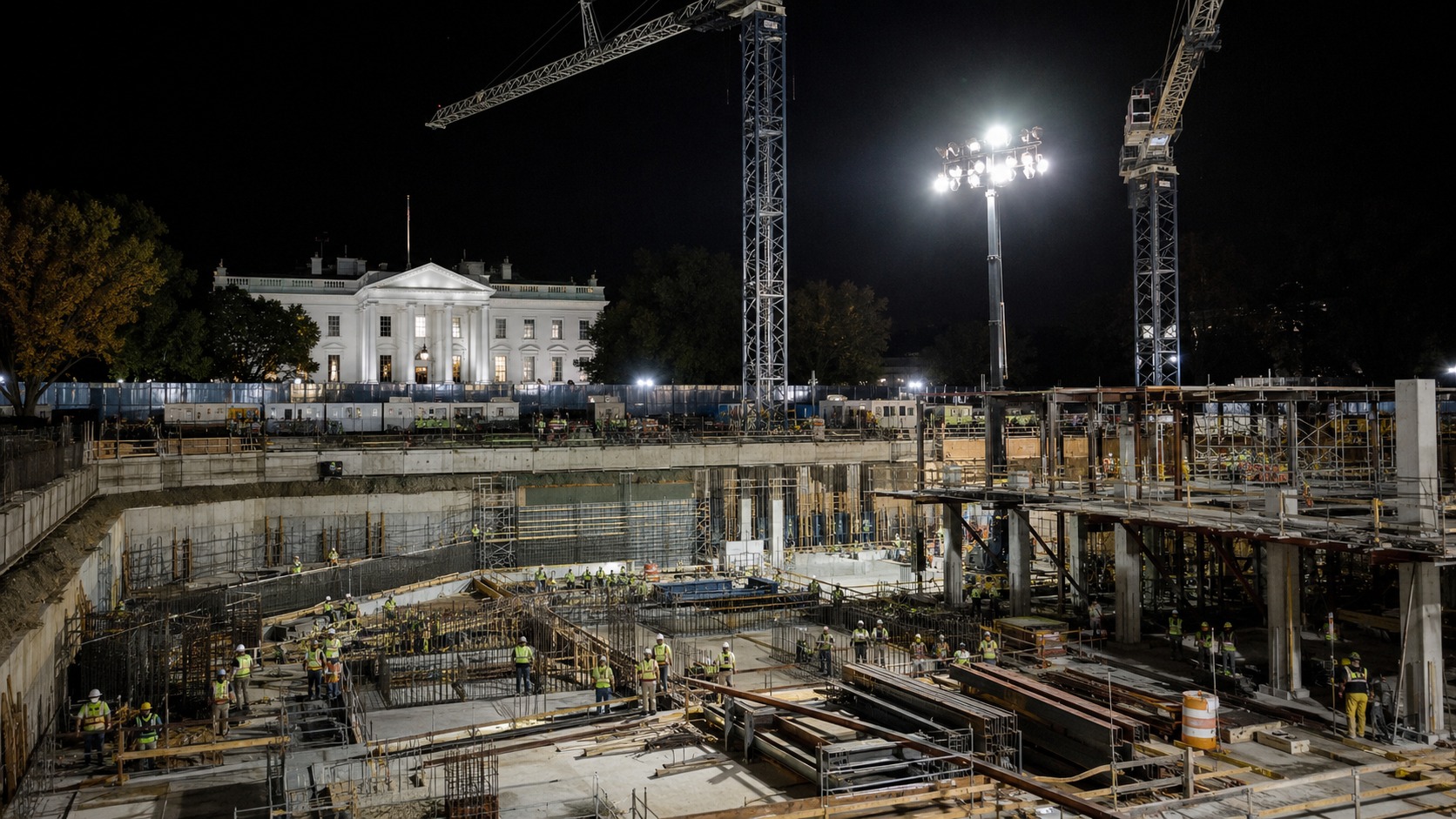
The Trump administration has told the Supreme Court that construction of the new White House ballroom has passed the point where a court could meaningfully undo it. In a filing asking the justices to lift a lower-court pause, government lawyers described a site running at extraordinary speed: roughly 250 workers on the job, shifts stretching up to 20 hours a day, and a structure officials say is already about two-thirds complete.
How the Ballroom Got to the Supreme Court
The project sits on the ground where the White House East Wing stood until it was demolished last fall. What replaced it is not a modest addition. The administration has described a structure five stories deep and roughly 70 feet above ground, spanning some 50,000 square feet of floor area, with a planned ballroom of about 90,000 square feet.
The National Trust for Historic Preservation went to court to stop it, arguing that a change of that scale to the White House complex cannot simply be ordered into existence. A three-judge federal appeals panel agreed to leave a pause in place by a 2-1 vote, concluding that the president does not hold unilateral authority to erect a structure of that size on that site. The pause applies to aboveground construction.
What the Administration Argues
The government is making two arguments at once. The first is procedural: it says the National Trust lacks standing to bring the suit at all, and that a preservation organization should not be able to halt a federal construction project through litigation.
The second is statutory. Federal law, the administration argues, has long given presidents authority over the care, maintenance, repair and alteration of the Executive Residence. Under that reading, deciding what the residence looks like is an executive housekeeping function, not something that requires outside sign-off.
Trump has also framed the structure in terms of security rather than decor, describing it in the Supreme Court bid as a “military complex” — language that casts the project as a functional necessity rather than an ornamental upgrade.
The Race Against the Clock
The pace described in the filing is the part that has drawn the most attention. Two hundred fifty workers, up to 20 hours a day, seven days a week, is not a normal construction schedule. It is the schedule of a project trying to reach a finish line before something stops it.
Opponents have made exactly that point to the justices. Their argument is that the administration is manufacturing a fait accompli — building fast enough that by the time the legal question is resolved, there will be nothing left for a court to save. Once the East Wing is gone and a 90,000-square-foot structure stands in its place, an order to stop construction becomes an order to demolish, and courts are far more reluctant to do that.
The Case for the Other Side
Supporters of the project counter that presidents have always altered the house they live in, and that treating a residence renovation as a matter for federal litigation sets a precedent with no clear stopping point. Every administration makes changes to the complex. The question is where the line sits between maintenance and reconstruction — and the administration says this project falls on the side the law has always allowed.
Preservationists say the line was crossed the moment the East Wing came down. What is at stake, in their view, is not one building but whether any part of the White House complex is protected from a single administration’s preferences.
What This Means for Americans
The White House is federally owned property, maintained with public money, and it functions as a national symbol as much as a residence. The outcome here sets a practical rule about how much a sitting president can reshape it without answering to anyone outside the executive branch — and how much weight a court order carries when the concrete is already curing. That rule will apply to the next administration, and the one after that.
The justices now decide whether work continues while the appeal is heard.
Stay informed on the stories that matter most. Follow Palmedia News on Facebook and bookmark palmedianews.com for breaking news and analysis.