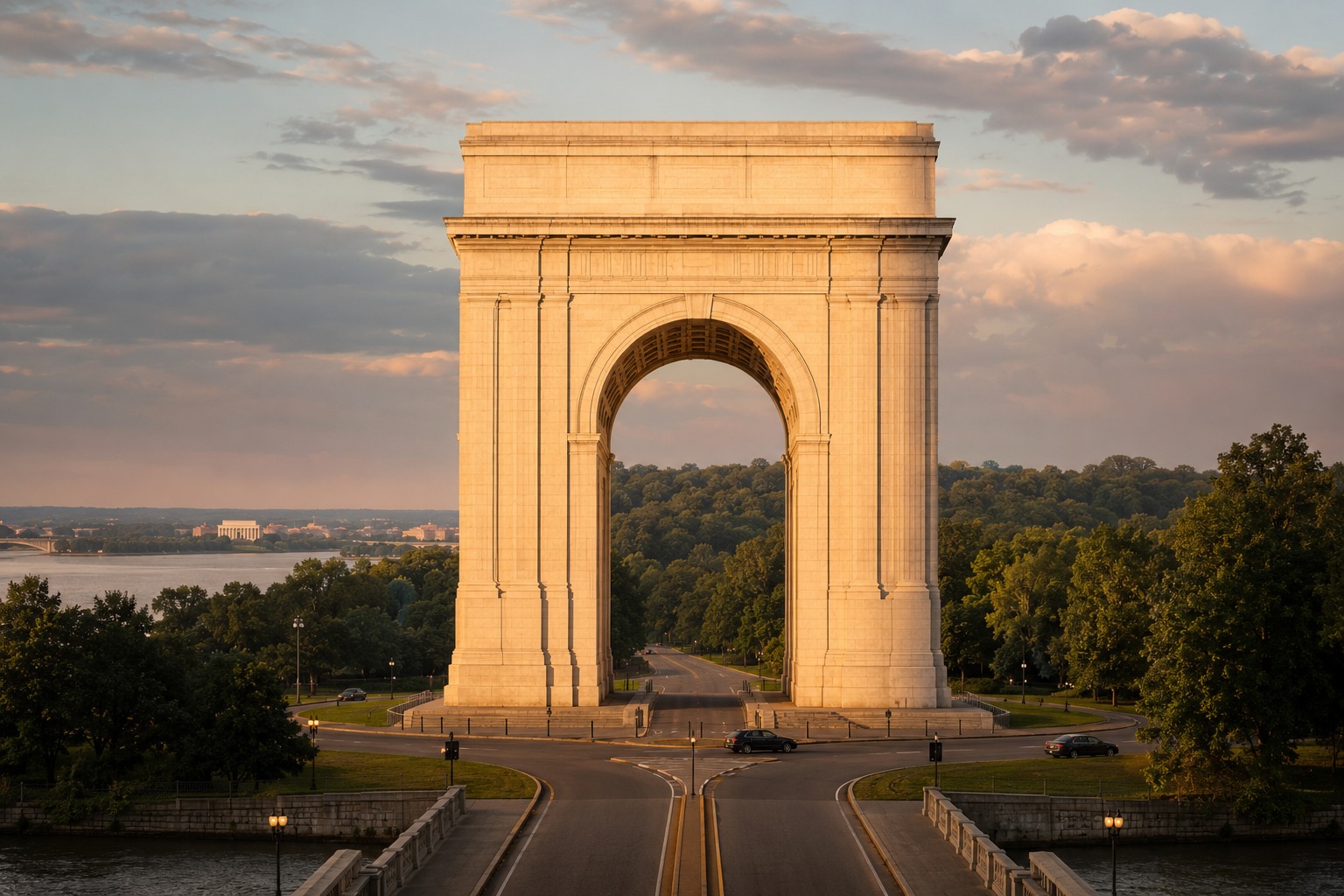
A 250-foot triumphal arch is one step closer to rising at the entrance to Arlington National Cemetery. The National Capital Planning Commission voted 8-1, with three members voting present, to grant preliminary approval to the site and building plans for the United States Triumphal Arch — the monument President Trump proposed in 2025 to mark the 250th anniversary of American independence.
The vote clears one of the largest remaining hurdles for a project that has drawn national attention since it was first sketched out. It does not, however, mean shovels are about to hit the ground.
Where the Arch Would Stand
The proposed site is Memorial Circle on Columbia Island — the traffic circle where the Arlington Memorial Bridge meets Memorial Drive. That road is not just any road. It is the ceremonial approach that runs straight into the gates of Arlington National Cemetery, the nation’s most sacred military burial ground, where more than 400,000 service members and their families are laid to rest.
The location is also one of the most carefully composed sightlines in the country. Memorial Bridge was designed to visually link the Lincoln Memorial on the Washington side of the Potomac with Arlington House on the Virginia side — a deliberate symbol of national reunification after the Civil War. Anything built at Memorial Circle sits squarely in the middle of that view.
The Scale Is the Story
At 250 feet, the arch would dwarf almost everything around it. The Lincoln Memorial, directly across the river, stands roughly 99 feet tall — meaning the arch would be more than two and a half times its height.
It would also tower over the monument it is modeled on. The Arc de Triomphe in Paris, the most famous triumphal arch in the world, rises about 164 feet. The American version would clear it by more than 80 feet, making it one of the tallest freestanding arches ever built.
The Design Has Already Been Changed Once
This is not the arch that was originally pitched. In May, the Commission of Fine Arts — a separate federal design review body — signed off on a revised concept only after the plan was reworked.
Two features were dropped: an eight-foot base that would have pushed the structure even higher, and four golden lions that were to flank the monument. The commission’s objection to the lions was blunt and specific — lions are not native to the United States, and the panel did not consider them an appropriate symbol for an American memorial. The height of the arch itself, 250 feet, survived the revision untouched.
Supporters and Critics
Supporters argue the country is about to mark its 250th birthday and has not built a civic monument on this scale in generations. To them, a permanent landmark at one of the most visible spots in the capital is exactly the kind of thing a nation should build for a semiquincentennial — something that will still be standing in another 250 years.
Critics see it differently. Their objection is less about the arch itself than about where it goes. Placing a 250-foot triumphal structure on the approach to a military cemetery, they argue, overwhelms a landscape that was deliberately designed for quiet remembrance. Arlington’s power comes from restraint — endless rows of identical white headstones, no grandeur, no hierarchy. A monument of this size at its gates changes the experience of arriving there, and permanently alters the Lincoln-to-Arlington sightline that planners spent a century protecting.
What Happens Next
The most important detail in this week’s news is the word “preliminary.” The National Capital Planning Commission granted preliminary approval — not final approval. The project still faces further federal review before construction can begin, and the design can still be modified, delayed, or blocked at later stages. The eight-foot base and the golden lions are proof that the review process does change things.
What This Means for Americans
Most people will never sit in a federal planning commission hearing. But nearly every American who visits Washington crosses Memorial Bridge or drives through Memorial Circle, and millions come to Arlington specifically to stand at a grave. This decision determines what they will see when they get there — for the rest of their lives, and their children’s. Monuments are one of the few government decisions that are effectively permanent. Once this one is built, it is not coming down.
Stay informed on the stories that matter most. Follow Palmedia News on Facebook and bookmark palmedianews.com for breaking news and analysis.