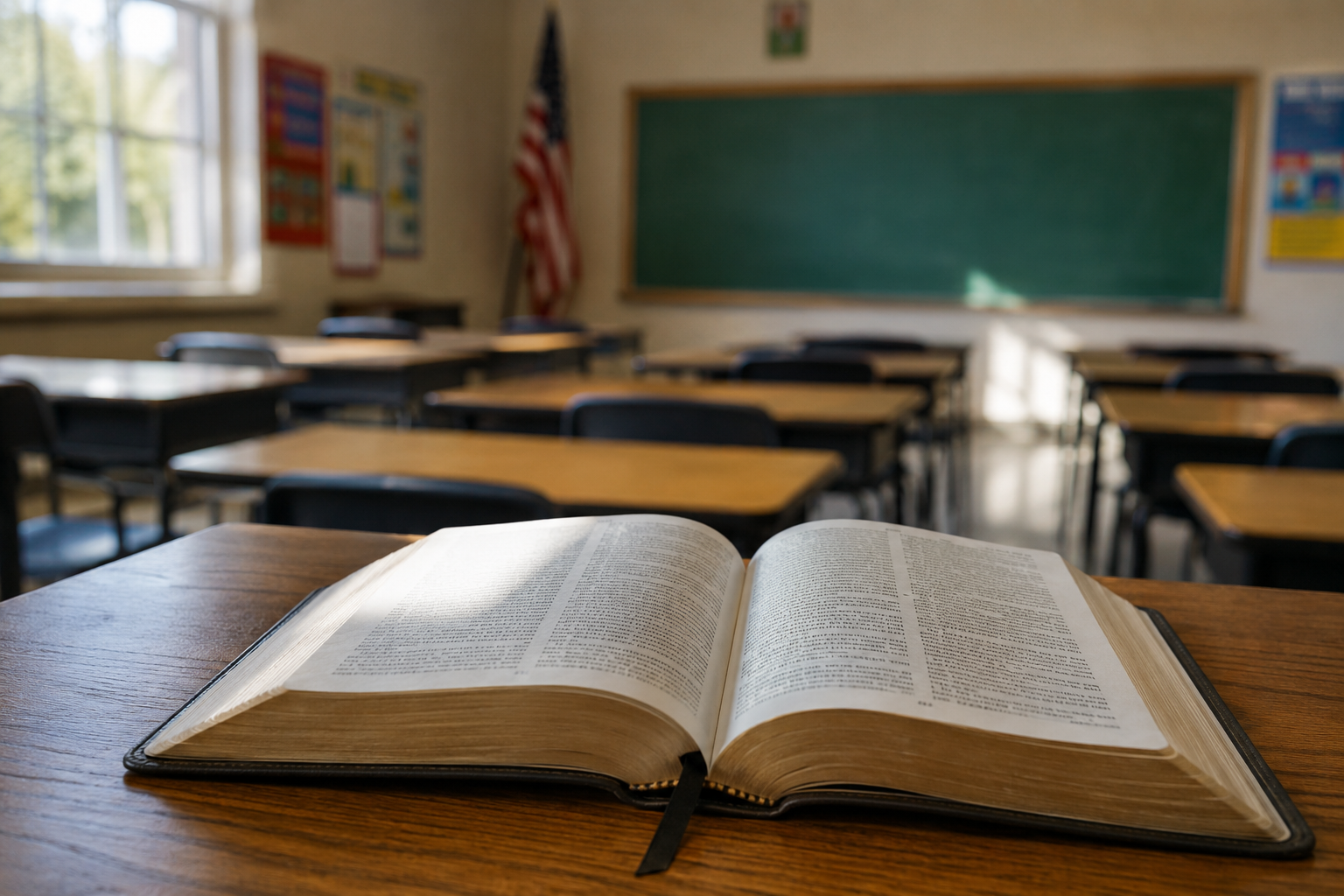
The Texas State Board of Education has voted to make Bible passages required reading for every public school student in the state, a decision that will reach more than five million children. The Republican-controlled board approved the new required reading list on Friday by a vote of 9-5-1, formally folding specific scripture passages into the curriculum that Texas public schools must teach.
What the Board Approved
The new list contains roughly 200 texts in all. Alongside essays and classic books, it weaves in a series of Bible stories and passages assigned by grade level. Elementary students would read a picture-book adaptation of the David and Goliath story. Older students would encounter Adam and Eve, sections of the Book of Exodus assigned to fifth graders, and the Shepherd’s Psalm assigned to seventh graders.
Crucially, this is not a list of suggestions. While many states publish recommended titles or optional resources for districts to consider, Texas may be the first state in the country to prescribe a single required literary canon that every public school student must study. That distinction is what has pushed a state curriculum decision into a national conversation.
Why This Matters
The question of religious texts in public classrooms has been litigated and debated for decades, but a binding statewide reading requirement raises the stakes. Texas is one of the largest public school systems in the nation, and what its board adopts often ripples outward, shaping textbook markets and influencing decisions in other states.
The requirements are not set to take effect immediately. According to the board, the new list will begin rolling out with the 2030-31 school year for elementary grades, giving districts, teachers, and publishers several years to prepare materials and lesson plans built around the approved texts.
The Debate
Supporters of the measure argue that the Bible is foundational to Western literature, history, and the development of the English language. In their view, students cannot fully understand the references, themes, and rhetoric that run through centuries of literature and American civic history without some grounding in the scripture those works draw upon. They frame the passages as part of a literary and historical education, not a religious one.
Critics see it differently. They contend that mandating scripture in public classrooms crosses the constitutional line on the separation of church and state, and they point out that no other religious texts made the required list. To opponents, singling out one faith’s sacred writings for mandatory study sends a message about which beliefs the state endorses, regardless of how the lessons are framed.
What This Means for Families
For Texas parents, the practical reality is still years away, but the direction is now set. Families in more than five million households will eventually have children assigned Bible passages as part of their standard coursework. Some will welcome the change as a return to a shared cultural inheritance; others will weigh whether the requirement fits their own beliefs and how their local schools choose to teach it. Either way, the decision guarantees that the conversation over faith, history, and public education is far from over.
Stay informed on the stories that matter most. Follow Palmedia News on Facebook and bookmark palmedianews.com for breaking news and analysis.