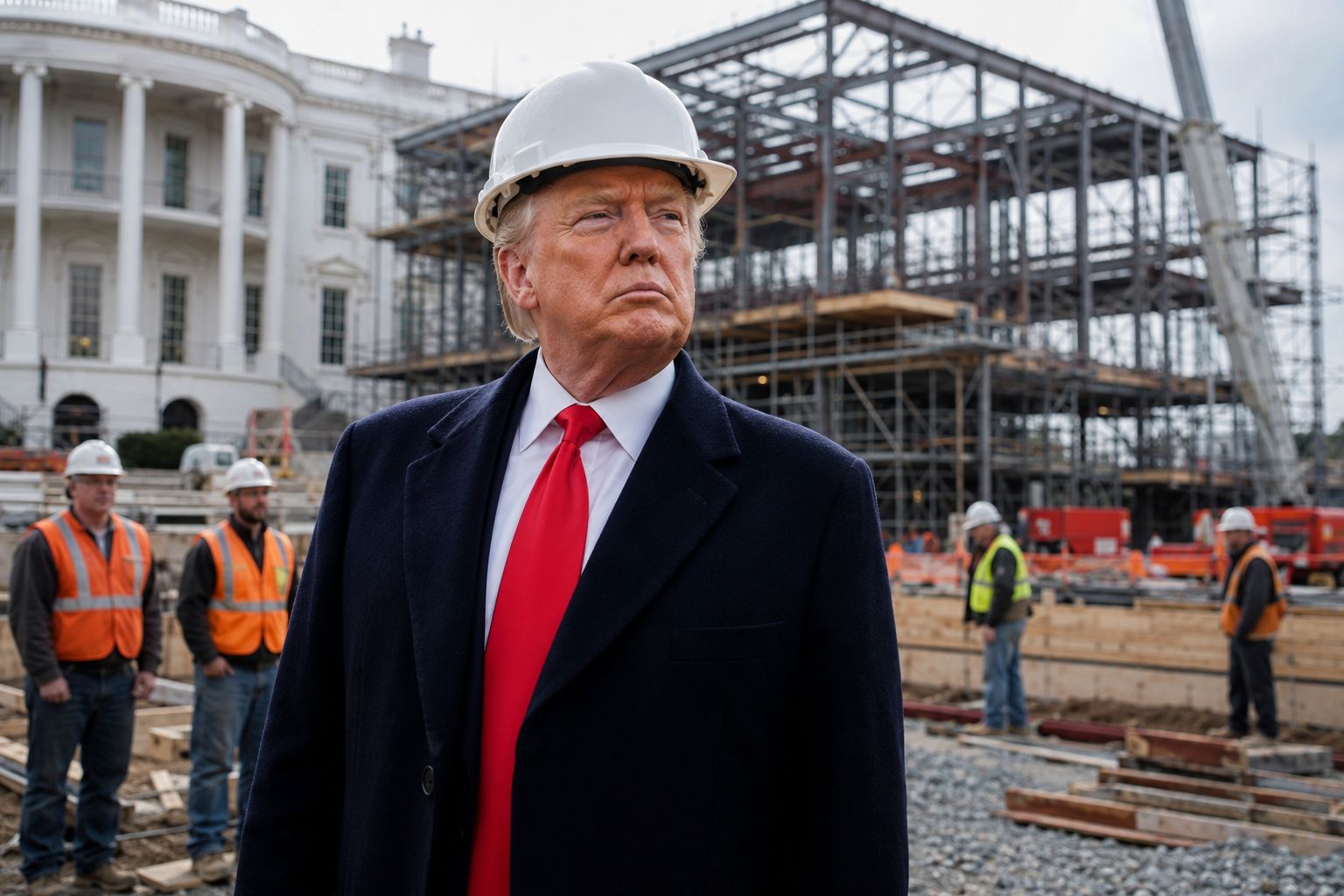
The Supreme Court on Monday allowed construction of President Donald Trump’s new White House ballroom to continue, handing the administration a win in the most visible building dispute in Washington. The vote was 5-4. The justices did not rule that the project is lawful. They ruled that the group challenging it likely does not have the legal standing to bring the case at all.
What The Court Actually Decided
The distinction matters more than the headline. The National Trust for Historic Preservation sued to stop the project, arguing that the president did not have unilateral authority to reshape the White House complex on his own. The Supreme Court’s order dismissed the challenger rather than the challenge. The majority concluded the Trust likely lacks standing, which is the legal requirement that a plaintiff show a concrete injury a court can address.
That is a procedural ruling with an enormous practical effect. Construction does not pause. Steel keeps going up. The lawsuit continues in the lower courts, but it now continues alongside an active building site rather than in place of one. Whatever a court eventually concludes about the legality of the project, it will be deciding about a structure that already stands.
The East Wing Came Down First
The dispute traces back to last fall, when the East Wing was demolished to make room for the ballroom. The East Wing had been part of the White House complex for generations and housed offices including the traditional workspace of the first lady’s staff.
Demolition is what turned a renovation argument into a legal fight. Once the wing was gone, preservation advocates argued there was no remedy a court could offer after the fact. A ruling can stop a project. It cannot rebuild something that has already been torn down. That asymmetry is at the center of why the timing of this order carries so much weight.
Roberts Breaks With The Majority
Chief Justice John Roberts sided with the court’s three liberal justices in dissent. He wrote that the construction is likely unlawful because Congress has not approved it.
The dissent is notable for more than its author. Days earlier, Roberts had written an interim decision in the same dispute holding that lower courts could not halt the construction while the case moved forward. Monday’s dissent clarifies what that earlier order was and was not. It was about process. It was not an endorsement of the president’s authority to build.
A federal appeals court had gone further, ruling that Congress never gave the president authority to renovate the exterior of what it described as the People’s House to fit the desires of one person. The Supreme Court’s order does not disturb that reasoning. It says only that this particular plaintiff may not be the one to press it.
A Fight Over Who Controls The White House
Underneath the standing question is a genuine constitutional argument about who decides what the White House looks like. Supporters of the project note that presidents have long exercised broad discretion over the residence and grounds, and that the complex has been altered repeatedly across its history, sometimes dramatically. They argue the ballroom fills a real need, giving the White House a large indoor space for state dinners and official events that currently require temporary tents on the South Lawn.
Critics counter that discretion over furniture and interior decor is not the same as authority to demolish a wing and erect a new structure without a congressional appropriation or approval. Their argument is that the building belongs to the public, not to whoever occupies it for four or eight years, and that permanent changes should require more than one person’s decision.
What This Means For Americans
For most people, the practical effect is simple: the ballroom is going to be built, and it will likely be finished before any court rules on whether it should have been. But the precedent underneath it reaches past this one building. The case asks how much a president can change a federal landmark without Congress, and whether a decision made quickly enough can outrun the legal process meant to review it. The answer will apply to future presidents of both parties.
The litigation is not over. The National Trust’s case continues, and other challengers with a stronger claim to standing could still come forward. For now, though, the cranes stay up.
Stay informed on the stories that matter most. Follow Palmedia News on Facebook and bookmark palmedianews.com for breaking news and analysis.