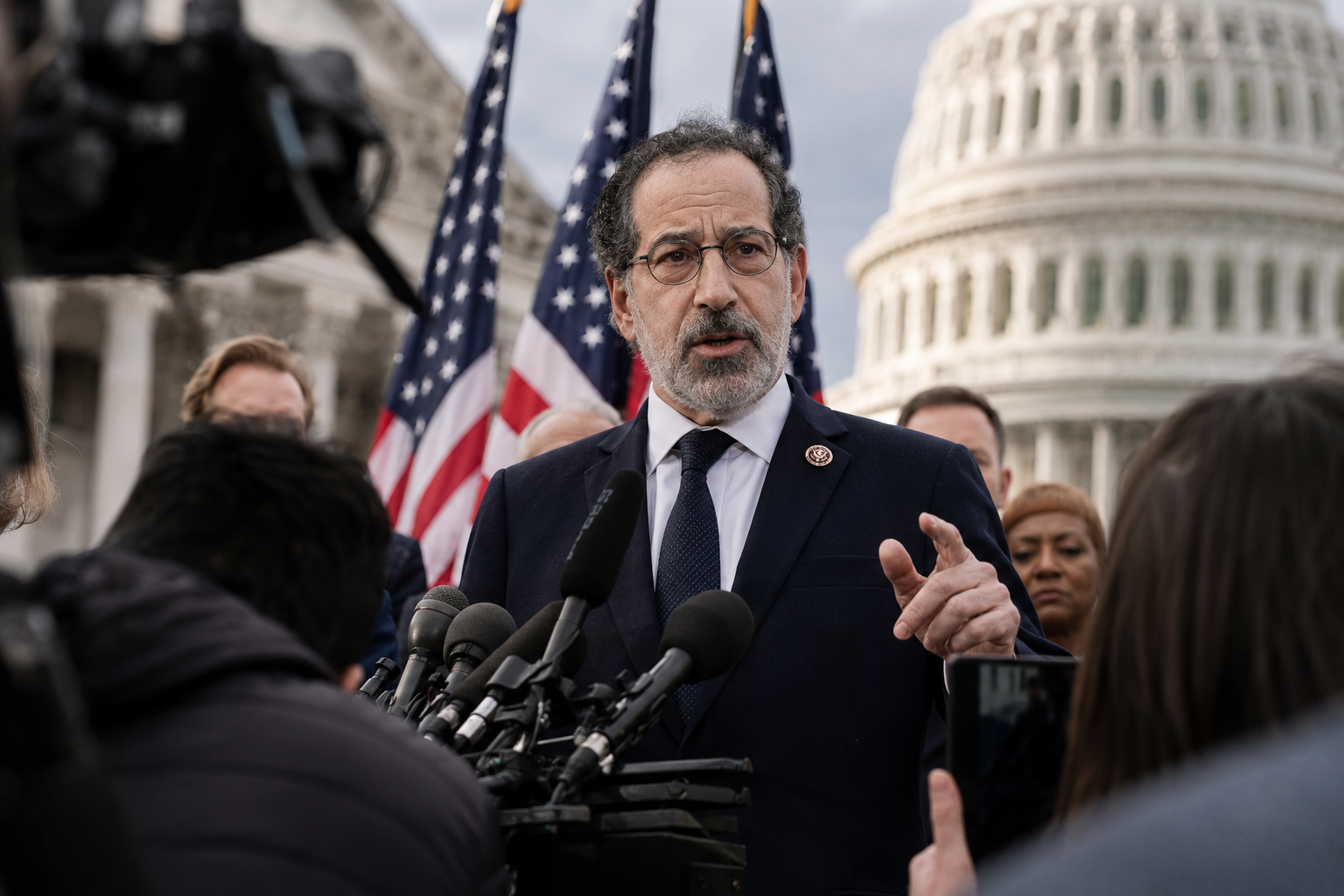
A sweeping new bill in Congress would make it illegal for any president to take money from the people they pardon, or from anyone they appoint to a powerful government post, and would force the public disclosure of such payments. The measure is part of a broad anti-corruption package introduced by House Democrats this spring.
Reps. Jamie Raskin of Maryland, Robert Garcia of California, and Joseph Morelle of New York introduced the Protecting Our Democracy Act on May 14. Sen. Adam Schiff introduced a companion version in the Senate. The legislation runs far wider than the pardon issue alone, but it is the pardon and appointment provision that has drawn the sharpest attention.
What the Pardon Provision Would Do
One section of the bill goes directly at what its sponsors call “pay-to-play” corruption. It would prohibit a president from accepting payments — including through a business the president owns — from people who receive a pardon or who are appointed to a federal position. Just as importantly, it would also make it illegal for those individuals to offer such payments in the first place, closing the loophole from both directions.
The pardon power is one of the few presidential authorities written into the Constitution with almost no external checks. A president can grant clemency to nearly anyone, for nearly any federal offense, without congressional approval or judicial review. The bill’s authors argue that this lack of oversight creates an opening for abuse if money or favors ever change hands around a clemency decision. By requiring disclosure of any payment connected to a pardon or appointment, the legislation aims to add a paper trail where one has never existed.
A Much Broader Package
The pardon language is just one piece of the Protecting Our Democracy Act. The full bill is designed to rebuild guardrails around the executive branch. It would codify the Constitution’s bans on foreign and domestic emoluments into enforceable law, preventing a president from profiting off foreign governments or public office. It would increase transparency over how the executive branch carries out spending laws, strengthen protections for whistleblowers, and limit the politicization of the civil service.
The package also targets election integrity. It would require presidential candidates to submit their tax returns to the Federal Election Commission, increase disclosure requirements for online political advertising, and add new safeguards against foreign interference in U.S. elections. Supporters describe the overall effort as a reassertion of congressional authority after years of expanding executive power.
The Backers and the Opposition
The bill arrives with significant support among House Democrats. It is cosponsored by 98 members of Congress and endorsed by a long list of government-watchdog and good-government groups, including Public Citizen, Citizens for Responsibility and Ethics in Washington, the Project On Government Oversight, Protect Democracy, and Common Cause. Raskin, the top Democrat on the House Judiciary Committee, has spent the past year introducing a series of measures aimed at curbing what his office characterizes as executive overreach and self-dealing.
The political reality is that the legislation faces steep odds. With Republicans controlling Congress, the bill is highly unlikely to reach the president’s desk in its current form. Supporters frame it less as an immediate legislative vehicle and more as a marker of what Democrats would prioritize if they win control of a chamber in the November midterm elections. Critics counter that it is a political message bill, crafted to spotlight the current administration rather than to become law, and some argue that reaching into the pardon power could raise constitutional questions.
What This Means for Americans
At its core, the debate is about transparency and the limits of presidential power. The bill would not abolish the pardon — it would require that any money tied to one be made visible to Congress and the public. For voters, that raises a basic question about accountability: whether the most unchecked power a president holds should come with a requirement to show who, if anyone, paid for it. Whether or not the bill advances, it has put that question squarely on the table heading into an election year.
Stay informed on the stories that matter most. Follow Palmedia News on Facebook and bookmark palmedianews.com for breaking news and analysis.