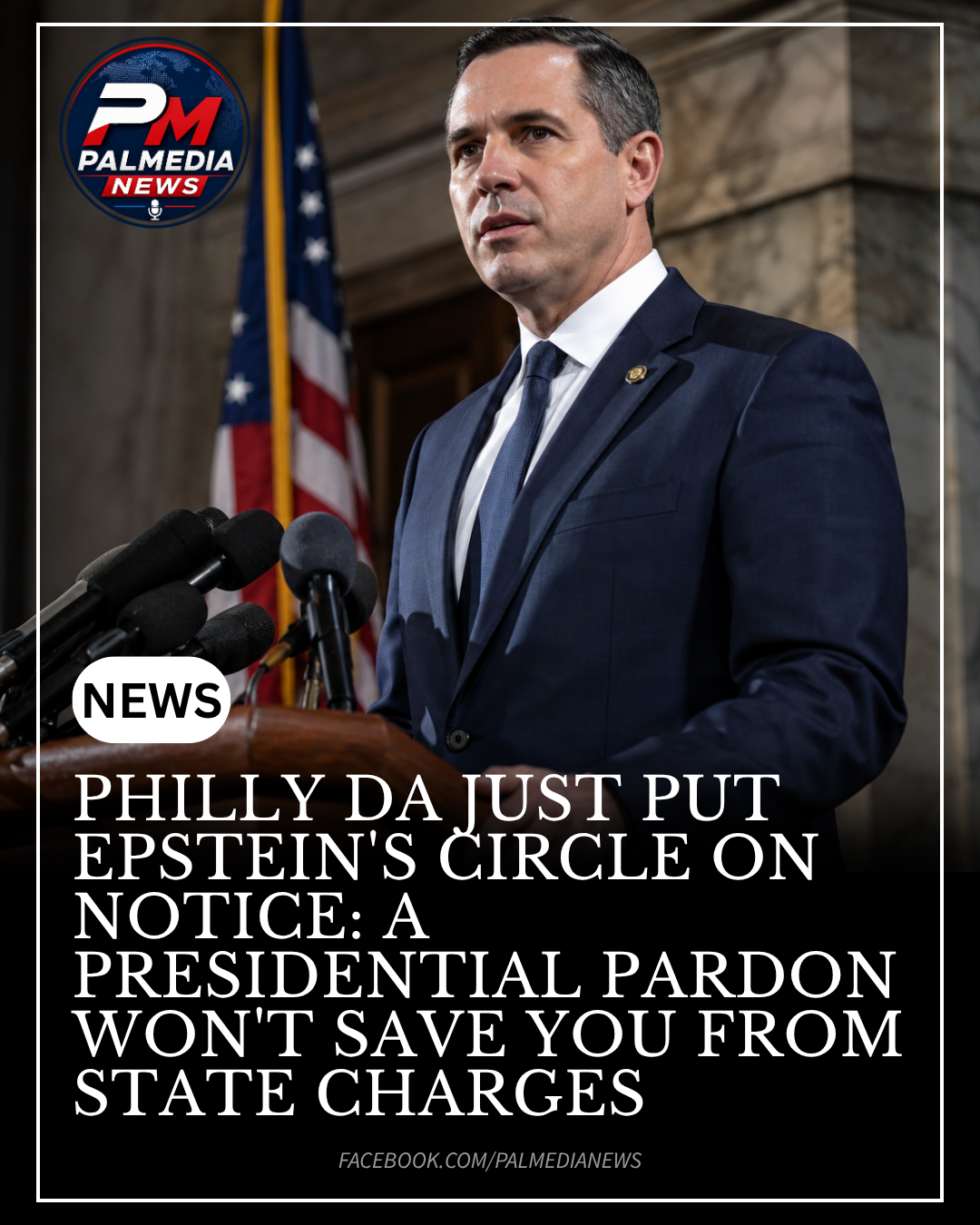
Philadelphia DA Larry Krasner just put everyone in Jeffrey Epstein’s orbit on notice — and the message couldn’t be clearer.
Krasner announced that his office is pursuing state-level charges against members of what he’s calling the “Epstein class” — the network of associates, enablers, and alleged abusers connected to the disgraced financier. The move is deliberate: state convictions cannot be pardoned by the President of the United States. No matter who sits in the White House, no matter what deals are struck at the federal level, a state sentence is one no president can erase.
“When we come for you and if we are able to convict you, the sentence you get you will serve because you cannot be pardoned by this or any other president,” Krasner said in a direct address to the targets of his investigation. He also noted that the statute of limitations in child victimization cases runs long — prosecutors have significant time to build and file these cases. That window isn’t closing anytime soon.
The announcement comes as Epstein-related pardon speculation has reached fever pitch in Washington. Acting Attorney General Todd Blanche told senators he would not recommend a pardon for Ghislaine Maxwell, Epstein’s convicted s*x-trafficking accomplice — but acknowledged the President retains unchecked authority to issue one anyway. In that environment of uncertainty, Krasner’s move represents a parallel track: state prosecution as a safeguard that federal political decisions cannot touch. A presidential pardon only covers federal offenses. State charges require a state pardon from a state governor — an entirely different political calculation.
The strategy is increasingly being adopted by state prosecutors across the country who are watching federal enforcement with unease. The principle is simple: in a system where federal executive power can effectively short-circuit federal criminal accountability, state charges become the backstop. Krasner has made clear he views his office as exactly that — an institution that answers to Pennsylvania law and Pennsylvania courts, not to whoever occupies the Oval Office.
For anyone in Epstein’s circle who believed a change in political winds or a well-timed presidential pardon might offer an exit, Krasner is drawing a hard line. The state of Pennsylvania answers to a different authority — and he intends to use every bit of it. The message to the “Epstein class” is unambiguous: there is no safe harbor in a federal pardon. State prosecutors are watching. State charges are coming. And state sentences stick.
How many charges are filed, against whom, and on what timeline remains to be seen. But the signal Krasner sent is clear: the legal exposure for those connected to Epstein did not expire with the federal investigation. In Pennsylvania, the clock is still running.