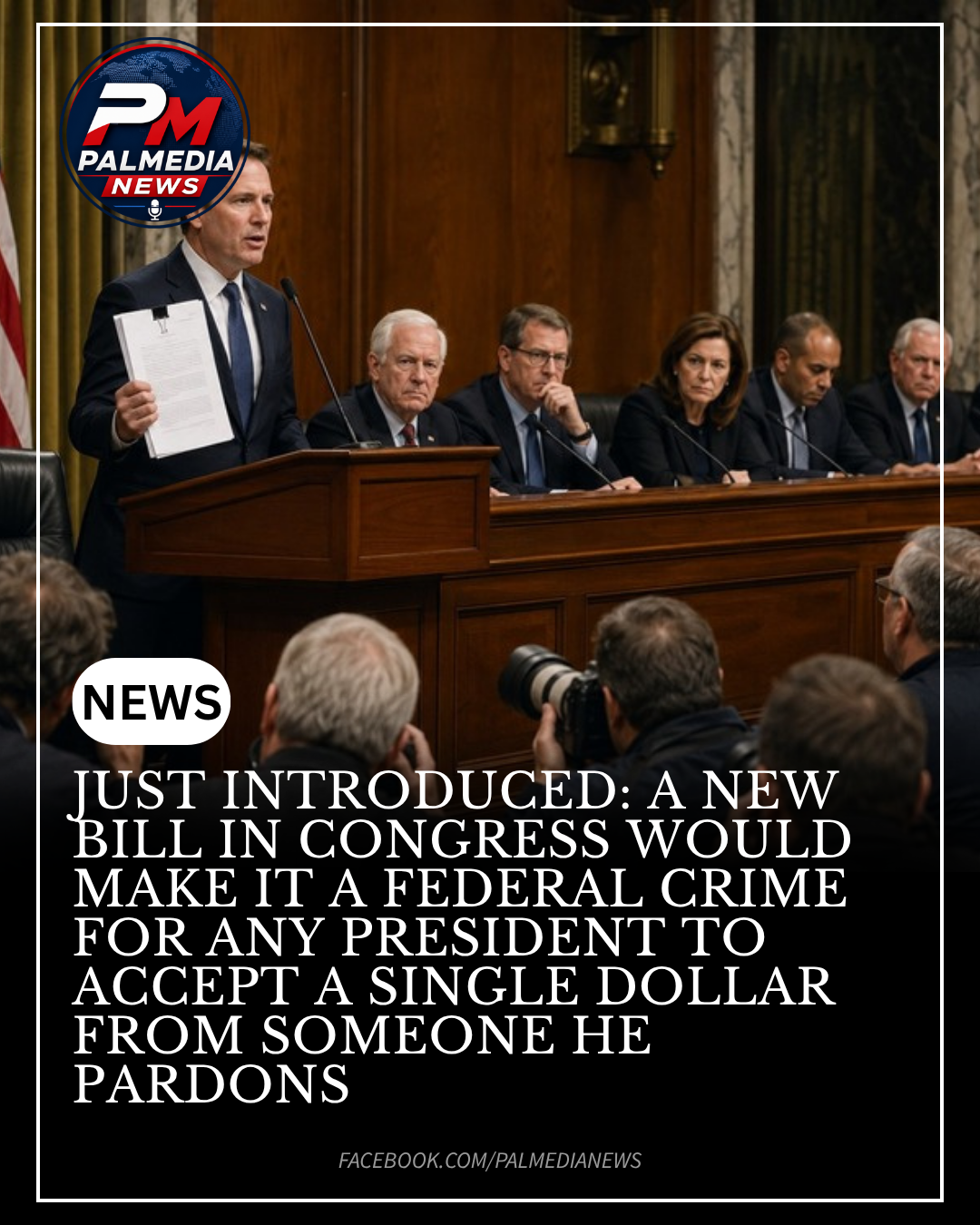
A newly introduced bill in Congress is taking direct aim at one of the most sweeping and least restricted powers an American president holds: the pardon. Under the proposed legislation, it would become a federal crime for any sitting president to accept money or payments from anyone they have granted clemency.
The idea is simple to state but enormous in scope. The measure would draw a bright legal line between the act of granting a pardon and any financial benefit flowing back to the person who signed it, closing what supporters describe as a long-standing gap in federal law.
The Loophole the Bill Targets
The presidential pardon power is written broadly into the U.S. Constitution. With a single signature, a president can erase a federal conviction, commute a sentence, or wipe away criminal liability entirely. Courts have historically treated that authority as nearly absolute, and it is one of the few executive powers that operates with almost no built-in checks.
What has troubled watchdogs for generations is what happens after the pardon is granted. As current law stands, there is little on the books that would stop a pardoned individual from later cutting the president a check, steering money toward a business, or writing a large donation as a gesture of gratitude. Critics argue that silence in the law creates an opening for exactly the kind of quiet, transactional arrangement that erodes public trust.
How the Measure Would Work
The bill would make it explicitly illegal for a president to accept a payment from a person they have pardoned, turning what is now a gray area into a clearly defined federal offense. Backers frame it as a straightforward anti-corruption safeguard built on a single principle: a pardon should never carry a price tag.
By putting the prohibition into statute, supporters say, the measure would give prosecutors a concrete tool and would remove any ambiguity about whether a pardon-for-cash arrangement crosses a legal line. The goal, in the words of its advocates, is to guarantee that clemency is granted on the merits and never as part of a financial exchange.
Supporters and Skeptics
Supporters call the bill a common-sense guardrail, arguing that the absence of such a rule has been an accident of history rather than a deliberate choice. They contend that no president of any party should be able to profit from the people they free, and that codifying the ban protects the integrity of the office regardless of who holds it.
Skeptics raise hard questions of their own. How, exactly, would such a law be enforced? Where is the line drawn on what counts as a payment, especially when money can move through businesses, family members, or third parties? And perhaps most significantly, could the measure survive a constitutional challenge, given how broadly the pardon power itself is written? Those debates are likely to shape the bill as it moves forward.
What This Means for Americans
For everyday Americans, the fight is less about legal technicalities and more about a basic question of fairness: should the power to forgive a crime ever be entangled with money? The bill has reignited a national conversation about whether one of the presidency’s oldest powers needs modern limits, and about how much trust the public is willing to place in the honor system that currently governs it.
For now, the legislation is newly introduced and faces a long road through committee, debate, and votes before it could ever become law. Its ultimate fate is uncertain, but the discussion it has sparked over accountability at the highest level of government is already well underway.
Stay informed on the stories that matter most. Follow Palmedia News on Facebook and bookmark palmedianews.com for breaking news and analysis.