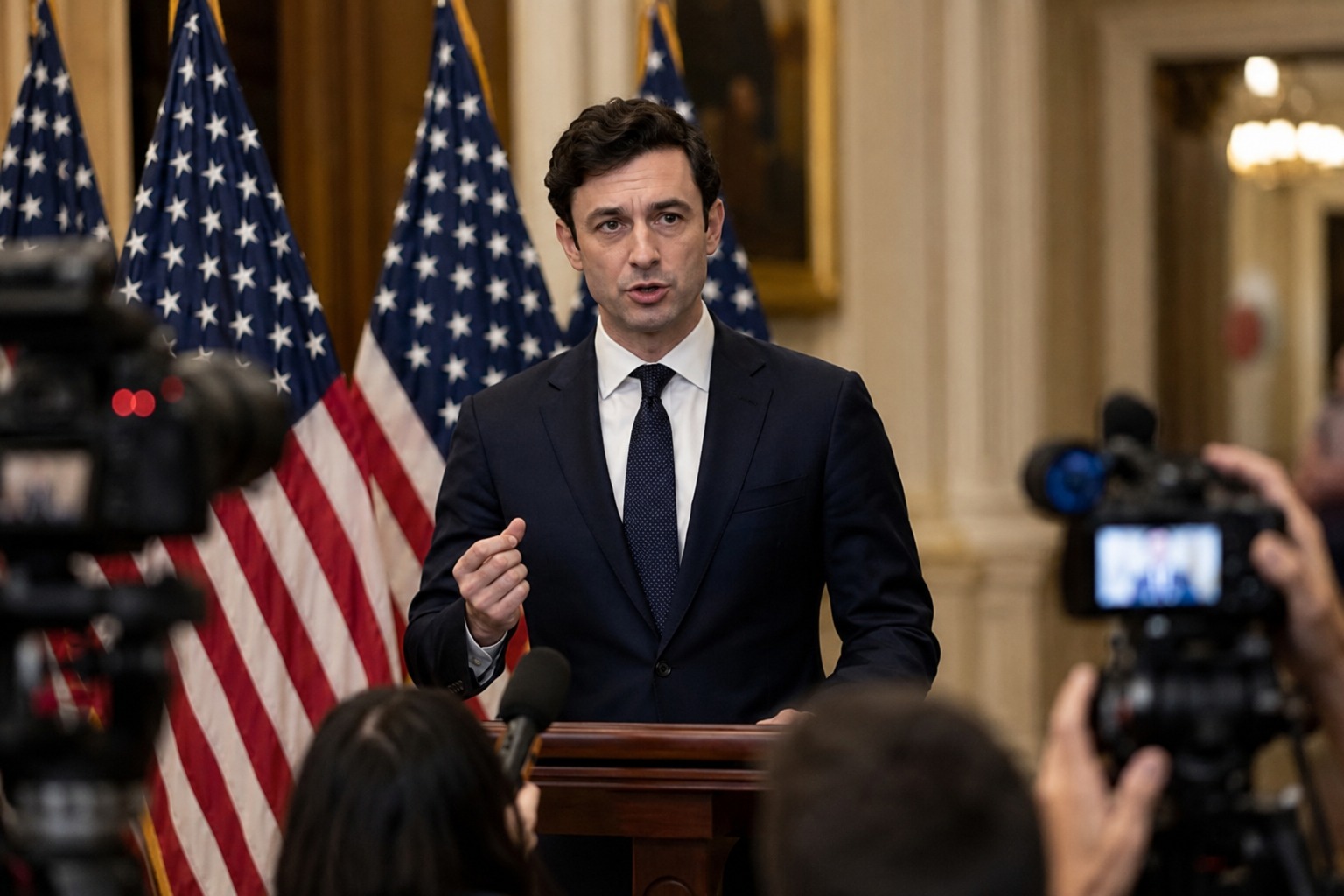
Senator Jon Ossoff of Georgia is calling for one of the most far-reaching changes to the American political system in a generation: a constitutional amendment to overturn the Supreme Court’s Citizens United decision and curb the flow of unlimited money into elections.
The proposal would do what no act of Congress alone can. By writing campaign-finance limits directly into the Constitution, Ossoff says lawmakers could put the question beyond the reach of any future court, ensuring that elections are decided by voters rather than by the deepest pockets.
What Citizens United Actually Did
The fight goes back to 2010, when the Supreme Court ruled 5-4 in Citizens United v. Federal Election Commission that the government could not limit independent political spending by corporations, unions, and outside groups. The majority held that such spending is a form of protected free speech under the First Amendment.
The practical effect was immediate and sweeping. The ruling helped give rise to super PACs, which can raise and spend unlimited sums to support or oppose candidates as long as they do not coordinate directly with a campaign. In the years since, billions of dollars have poured into federal elections through these channels, much of it difficult for ordinary voters to trace back to its original source.
Supporters of the decision argue it protects the right of Americans and the organizations they belong to to speak freely about politics and to spend money advancing the causes they believe in. Critics counter that it handed outsized influence to the wealthiest donors and corporations, drowning out the voices of everyday citizens.
Ossoff’s Proposal
Ossoff has long argued that legislation alone cannot fix the problem, because any statute restricting campaign spending could be struck down by the same court that decided Citizens United. A constitutional amendment, he contends, is the only durable solution.
He has framed the effort as a fight to return power to ordinary voters, insisting that elections should be settled by people and ideas rather than by the size of a donor’s checkbook. The goal, in his telling, is to restore public confidence that representatives answer to their constituents, not to a small circle of major financial backers.
An Uphill Climb
Amending the Constitution is deliberately difficult. A proposed amendment must clear a two-thirds vote in both the House and the Senate, then be ratified by three-quarters of the states — 38 of the 50. That is a steep bar, and it has only been cleared 27 times in the nation’s history.
No effort to overturn Citizens United has come close to meeting that threshold in the 16 years since the decision was handed down. Members of Congress have introduced amendment proposals and stand-alone bills nearly every year, but none has gained the broad bipartisan support required to advance. Ossoff’s renewed push faces the same daunting math.
The Debate It Reopens
Whatever its odds, the proposal revives a debate that has simmered for more than a decade. To supporters of an amendment, unlimited political spending is a threat to the basic fairness of elections and a corrosive force in public life. To opponents, capping that spending would amount to government restrictions on political speech — exactly what the First Amendment was written to prevent.
Polling over the years has consistently shown that large majorities of Americans across the political spectrum express unease about the role of money in politics. Translating that broad sentiment into the supermajorities needed to change the Constitution, however, has proven far harder than rallying public frustration.
What It Means for Americans
For voters, the stakes are straightforward. The rules governing campaign money shape which candidates can afford to run, whose messages dominate the airwaves, and how much sway major donors hold over the lawmakers they help elect. A change of this magnitude would ripple through every future campaign in the country — from the presidency down to local races.
Stay informed on the stories that matter most. Follow Palmedia News on Facebook and bookmark palmedianews.com for breaking news and analysis.