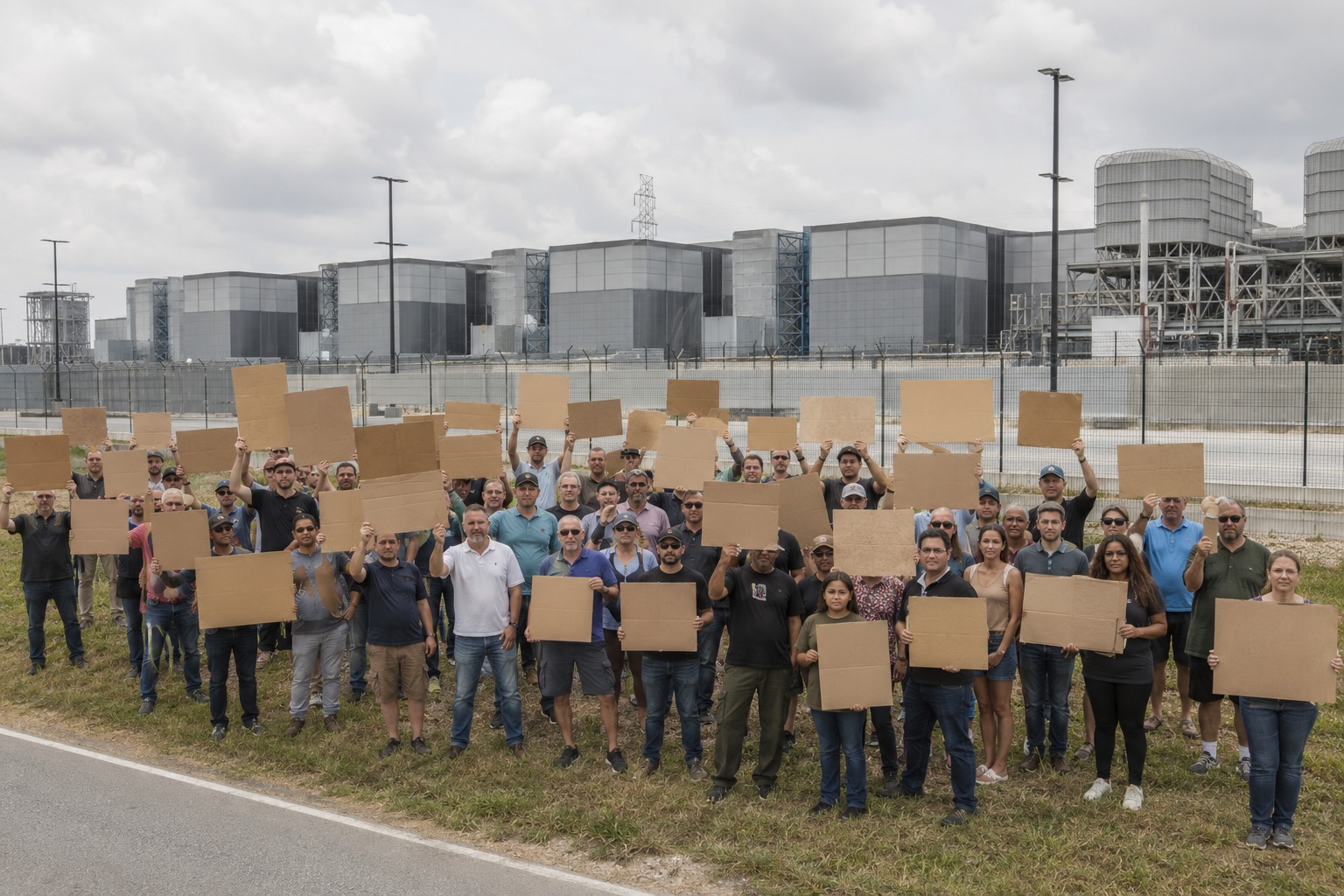
On July 18, Americans in more than 50 cities across 22 states will walk out of their homes at the same hour for the first nationwide day of protest against AI data centers. It is the first coordinated national demonstration against the sprawling server farms that now power America’s artificial intelligence boom.
The organizer is Humans First, a group led by Amy Kremer, a longtime conservative activist and former Tea Party organizer. The group’s stated mission is to protect hometowns, wallets, and daily life from data centers it says were forced onto communities in backroom deals.
Why Data Centers Became a Flashpoint
Data centers are the physical backbone of artificial intelligence. Every chatbot query, every generated image, every model trained on billions of parameters runs on racks of servers housed in vast windowless warehouses. As the AI race accelerated, technology companies raced to build them, and they built them fast.
The buildings arrived in rural counties and suburban edges across the country, often in places where land was cheap and local officials were eager for tax revenue. Many deals were negotiated quietly. Residents frequently learned a facility was coming only after the paperwork was signed.
The Complaints
The grievances are remarkably consistent from state to state. Electricity is the biggest one. Data centers consume enormous amounts of power, and residents in several regions say their utility bills have climbed as the grid strains to keep up.
Water is the second. Cooling banks of servers requires millions of gallons, and in drought-prone areas that has put data centers in direct competition with farms and households. Noise is the third. The cooling systems run around the clock, producing a persistent low-frequency hum that neighbors describe as inescapable.
Beyond that, residents cite construction traffic, industrial light pollution, and falling property values for homes that now sit in the shadow of a warehouse complex the size of several shopping malls.
A Rare Point of Agreement
Polling suggests this is not a fringe concern. A Gallup survey found that more than 70% of Americans do not want a data center built near where they live. In a country divided on nearly everything, that is an unusually broad consensus.
The protest map reflects it. Demonstrations are planned from California to Florida, in red states and blue states alike. The movement has drawn conservatives worried about property rights and local control, and progressives worried about water, energy, and emissions. They are arriving at the same street corner from opposite directions.
The Other Side of the Argument
Supporters of the buildout make a straightforward case. Data centers generate substantial property tax revenue for counties that often have little else. They bring construction jobs during the build phase. And they argue the infrastructure is essential if the United States intends to lead in artificial intelligence rather than cede that ground to competitors abroad.
Opponents counter that the permanent job count is small once construction ends, that the tax abatements offered to land these facilities are often generous enough to erase much of the promised revenue, and that the costs, in power bills, water, and noise, are paid by everyone who lives nearby.
What This Means for Americans
For most households, this fight shows up on the utility bill. The electricity that runs an AI model is drawn from the same grid that runs a refrigerator, and when demand rises faster than supply, rates follow. The July 18 protests are, at their core, an argument about who pays for the AI boom and who decides where it gets built.
July 18 will be the first real measure of how many people are willing to show up.
Stay informed on the stories that matter most. Follow Palmedia News on Facebook and bookmark palmedianews.com for breaking news and analysis.