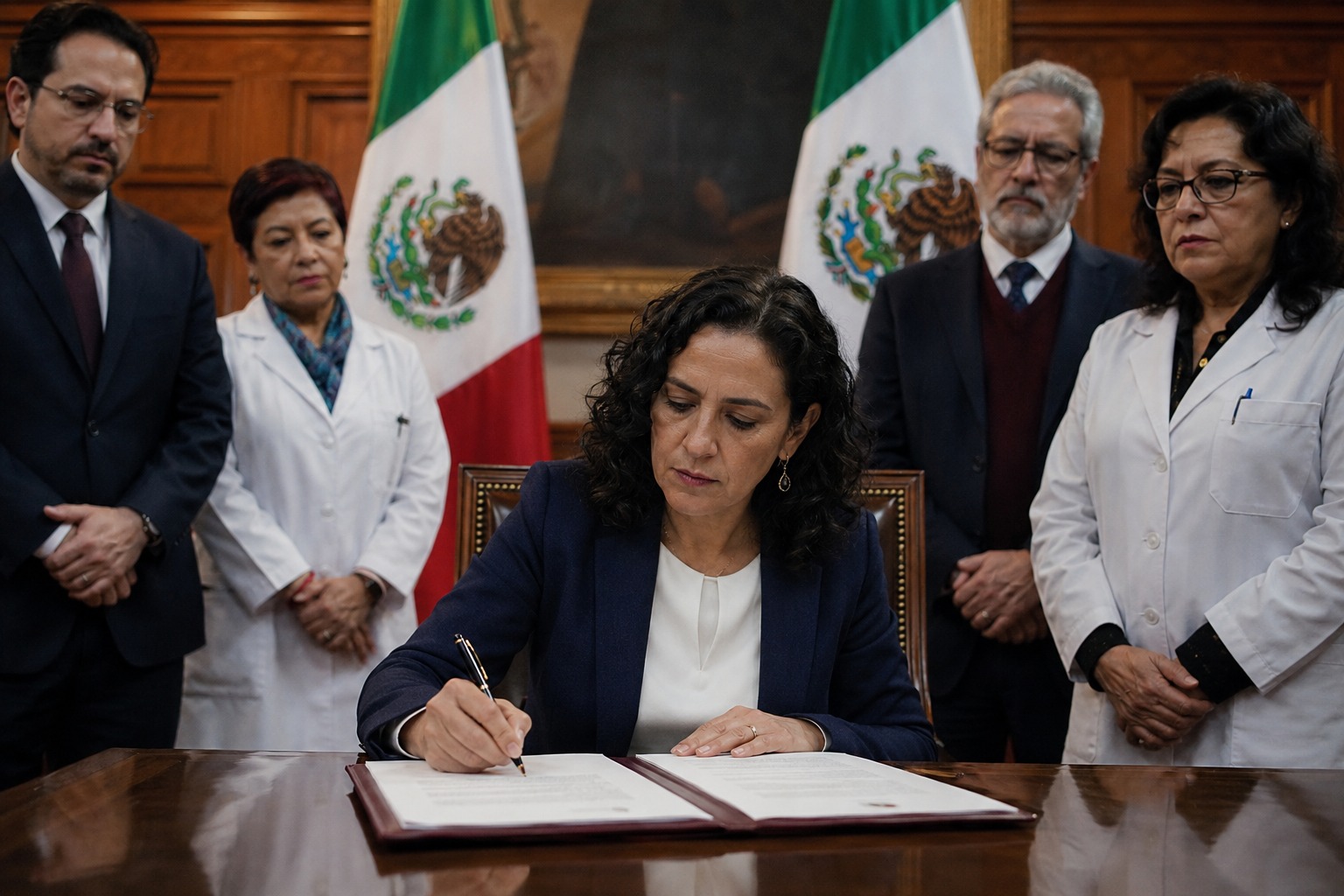
Mexico has set out to do something few countries its size have attempted: guarantee free public healthcare to every single resident. President Claudia Sheinbaum signed a decree creating a new Universal Health Service, a framework designed to extend medical coverage to all 130 million people living in the country regardless of whether they hold a job, carry insurance, or have neither.
Why This Matters
For decades, Mexico’s healthcare system has been fragmented. Coverage depended largely on a person’s employment status, splitting the population across separate institutions that did not always talk to one another. A formal-sector worker, a government employee, and an uninsured resident could each end up in a different system with different rules, different facilities, and very different access to care.
That fragmentation left millions navigating gaps and dead ends, particularly people who moved between jobs or worked in the informal economy. The new decree is Sheinbaum’s answer to that problem, and it doubles as a statement of national priorities: healthcare framed as a right rather than a benefit tied to a paycheck.
What The Decree Actually Does
Rather than building a brand-new bureaucracy from scratch, the plan knits together Mexico’s three major public health institutions — IMSS, ISSSTE, and IMSS-Bienestar — into a single connected network. The goal is straightforward: a patient should be able to walk into any public facility and receive treatment, no matter which program they technically belong to.
The rollout is deliberately phased rather than instant. Beginning in 2026, Mexicans start receiving a national health identification card that also functions as official ID, with adults 85 and older first in line. Cross-institutional care for emergencies — heart attacks, strokes, high-risk pregnancies, and certain cancers — is slated to begin in 2027. Full integration of the systems is targeted for 2030.
That timeline matters. Universal coverage on paper is one thing; the harder work is making separate institutions share patients, records, and resources without overwhelming hospitals that are already stretched. The staggered approach is meant to give the system room to absorb the change.
The Wage Story Running Alongside It
The healthcare push lands at the same time as another headline number: Mexico’s minimum wage has risen a cumulative 154% since 2018. Sheinbaum has pointed to that figure as proof that long-standing warnings were wrong. Critics had argued for years that sharp minimum-wage increases would trigger runaway inflation and scare off investment.
Instead, the government says, the increases arrived alongside record levels of foreign investment, not the economic damage opponents predicted. For working-class families, the practical effect is a larger paycheck paired with the promise of medical care that no longer hinges on the type of job they hold.
Supporters, Skeptics, And The Budget Question
Supporters are calling the move a model the rest of the region should study, an example of a large, middle-income country committing to universal coverage on a defined schedule. They argue that consolidating existing institutions, rather than inventing new ones, is the most realistic path to getting there.
Skeptics raise a harder question: can the budget actually sustain free care for more than 120 million people without overwhelming public hospitals? The concern is not the ambition but the math — staffing, supplies, and facilities all have to scale alongside the promise. The phased timeline buys time, but the financing will be tested at every step.
What This Means For Readers
Mexico’s experiment is being watched well beyond its borders. In countries where universal healthcare is treated as politically impossible, a neighbor attempting it on a fixed timeline becomes a real-world test case. If it works, it strengthens the argument that coverage can be expanded by integrating existing systems rather than dismantling them. If it falters on cost or capacity, it will give skeptics a concrete example to point to. Either way, the outcome will inform the debate for years.
Stay informed on the stories that matter most. Follow Palmedia News on Facebook and bookmark palmedianews.com for breaking news and analysis.