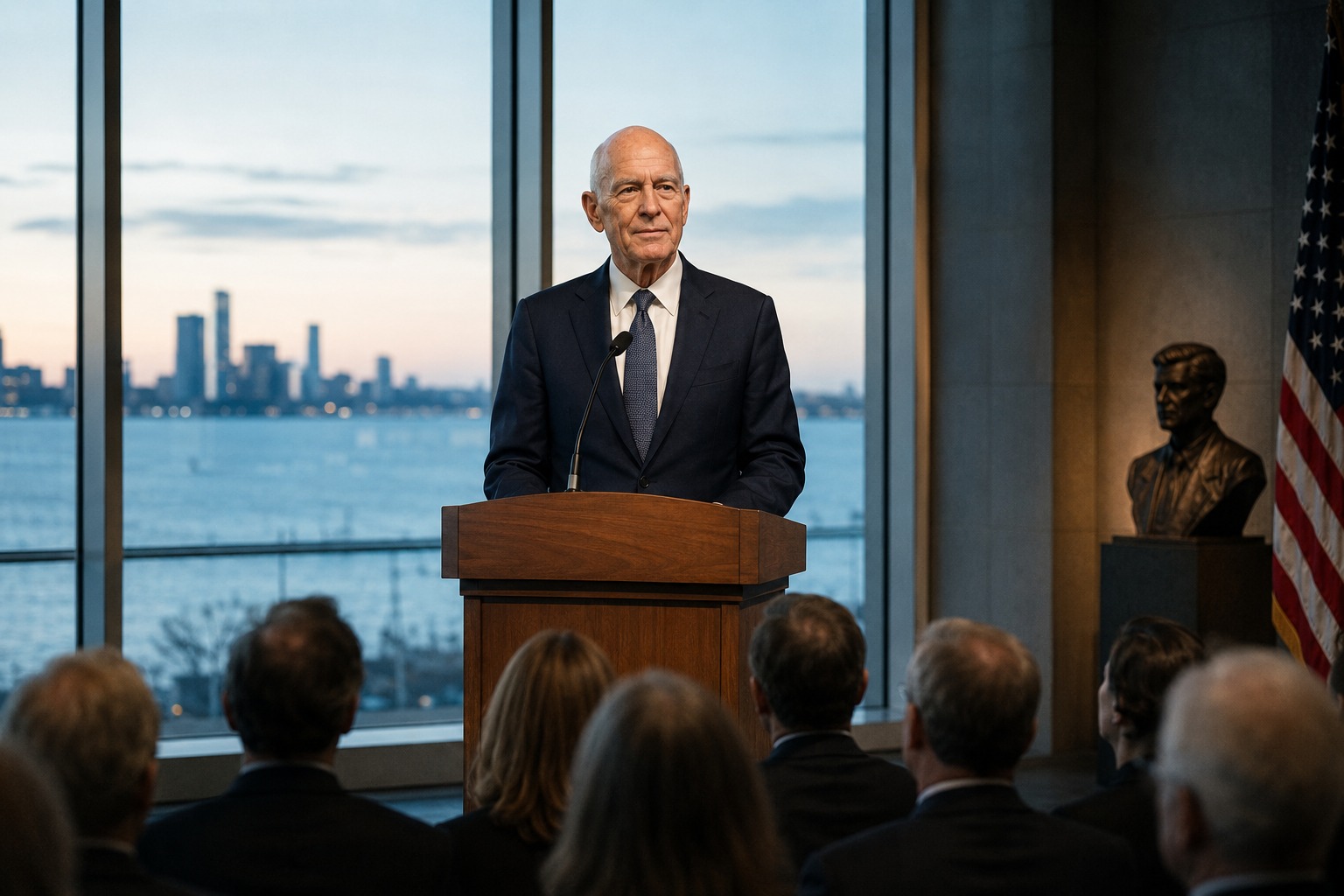
Jerome Powell, the former chair of the Federal Reserve, accepted the John F. Kennedy Profile in Courage Award on Sunday at the Kennedy Presidential Library in Boston, honored for protecting the central bank’s independence through years of personal attacks and threats from the highest levels of government.
Standing at a podium with Boston Harbor behind him, Powell never named the president who spent much of Powell’s tenure publicly criticizing him. He did not need to. The award itself, and the speech he delivered to accept it, made the subtext unmistakable.
Why the Award Matters
The Profile in Courage Award is given each year by the John F. Kennedy Library Foundation to public servants who take principled stands despite intense pressure. Named for President Kennedy’s Pulitzer Prize-winning book, it has gone to senators, judges, activists, and whistleblowers who put duty ahead of their own careers or safety.
For Powell, the recognition centered on a single principle: the independence of the Federal Reserve. The central bank sets interest rates and steers monetary policy insulated from day-to-day political demands, a structure designed so that economic decisions are not bent to the short-term needs of whoever holds power. That independence came under sustained strain during Powell’s years atop the Fed.
What Powell Said
In his acceptance speech, Powell called universities, the courts, Congress, and the central bank “the foundation and the embodiment of our democracy.” He described the Fed’s independence as a “priceless asset” — one that must be defended rather than surrendered the moment it becomes politically inconvenient.
His message extended beyond monetary policy. Powell warned against political pressure on the institutions that anchor American public life, arguing that they hold only when the people inside them refuse to bend. He delivered the remarks calmly, without raising his voice, after years in which he was pressured to cut interest rates faster, criticized by name, and at times had his job security openly questioned.
The Kennedy Family Weighs In
Caroline Kennedy and her son, Jack Schlossberg, framed the stakes in stark terms. In a statement, they said that without people “willing to put their lives on the line to hold America to its promises,” American democracy “can’t survive.” The award this year also recognized community leaders from Minnesota’s Twin Cities, honored alongside Powell for their own stands.
Supporters and Critics
Supporters of Powell view the honor as a long-overdue vindication for a public servant who absorbed years of criticism without abandoning his post or his principles. To them, his refusal to politicize interest-rate decisions is exactly the kind of institutional backbone the award was created to celebrate.
Critics counter that the Federal Reserve wields enormous power over the economy with limited democratic accountability, and that an unelected central bank should be more responsive to elected leaders, not less. For them, “independence” can shade into insulation from the public’s will. The debate over how much autonomy the Fed should have is unlikely to fade.
What This Means for Americans
The fight over the Fed’s independence is not abstract. The central bank’s decisions shape mortgage rates, credit card interest, the cost of car loans, and the broader health of the job market. Whether those calls are made on economic grounds or political ones touches nearly every household budget in the country — which is why a ceremony in a Boston library reverberates far beyond it.
Stay informed on the stories that matter most. Follow Palmedia News on Facebook and bookmark palmedianews.com for breaking news and analysis.