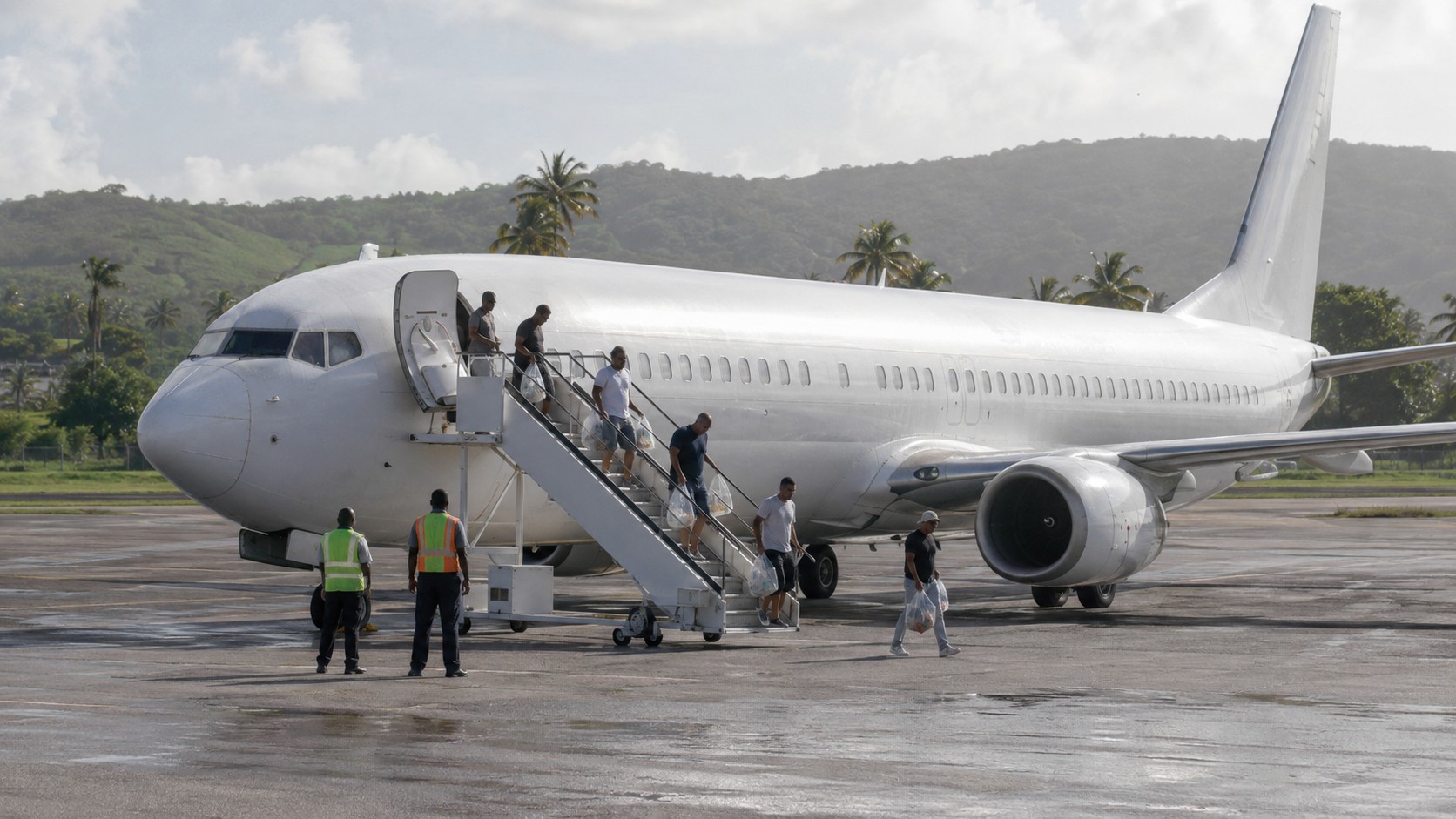
An Immigration and Customs Enforcement flight carrying 161 people landed at Cap-Haitien International Airport on Thursday, the first United States deportation flight to Haiti since temporary protected status for Haitian nationals came to an end.
The aircraft departed from Alexandria, Louisiana, one of the primary staging points ICE uses for removal flights. It did not land in Port-au-Prince. The capital’s main international airport has been closed to most commercial traffic because of gang violence in the surrounding neighborhoods, so the flight was routed instead to Cap-Haitien, a port city on Haiti’s northern coast roughly 85 miles from the capital.
Who Was on the Flight
Haiti’s National Office of Migration, the government agency that receives and processes returning nationals, said the group included both former temporary protected status holders and Haitian nationals who had completed criminal sentences in the United States. Arriving passengers were processed at the airport by migration officials before being released.
The agency has handled returns from the United States before, including during earlier rounds of removals, but the end of TPS substantially widens the pool of people who can now be placed on these flights.
How Temporary Protected Status Ended
Temporary protected status is a designation the Department of Homeland Security can extend to nationals of countries experiencing armed conflict, natural disaster, or other extraordinary conditions that make safe return difficult. It is not a path to permanent residency. It is a temporary shield from removal, renewed in fixed increments, and it can be withdrawn when the government determines conditions have changed.
Haiti’s designation dated back years and had been repeatedly extended. The current administration moved to end it, and the effort was contested in federal court. In June, the Supreme Court issued an order allowing the wind-down to proceed, clearing the way for the loss of protections for more than 350,000 Haitians.
Haiti was not the only country affected. TPS designations for several other nations, including Ethiopia, Somalia, Syria, and Myanmar, were ended in the same broader wave of terminations.
Conditions on the Ground
Haiti remains one of the most unstable countries in the Western Hemisphere. Armed groups control large sections of Port-au-Prince, and the closure of the capital’s airport to most traffic is itself a measure of how limited government control has become. Hundreds of thousands of Haitians are internally displaced, and humanitarian organizations have repeatedly described the situation as a severe crisis.
That instability is the central fact both sides of this debate point to, and they reach opposite conclusions from it.
The Argument in Favor
Supporters of ending the designation make a straightforward case. Temporary protected status was designed to be temporary, and repeated extensions over many years effectively turned a short-term humanitarian measure into an indefinite immigration status that Congress never authorized. They argue that final removal orders issued by immigration courts have to mean something, and that carrying them out is the executive branch’s basic obligation under the law. They also note that the Supreme Court declined to block the termination.
The Argument Against
Critics argue that the conditions TPS was written for are precisely the conditions Haiti is in right now, and that the timing is the problem. They point to the gang control of the capital, the displacement figures, and the closure of the main airport as evidence that safe return is not realistic for many people. Immigrant advocacy organizations have also raised concerns about people who have lived and worked legally in the United States for a decade or more, built families here, and now face removal to a country many have not seen in years.
What Happens Next
More flights are expected. ICE has not published a schedule, and the pace will likely depend on capacity at Cap-Haitien, coordination with Haitian authorities, and how quickly individual cases move through the removal process.
For now, the first flight is the data point everyone is reading. Supporters see the start of enforcement that had been delayed for years. Critics see the beginning of returns to a country they say cannot absorb them. How many flights follow, and how quickly, will determine which reading holds up.