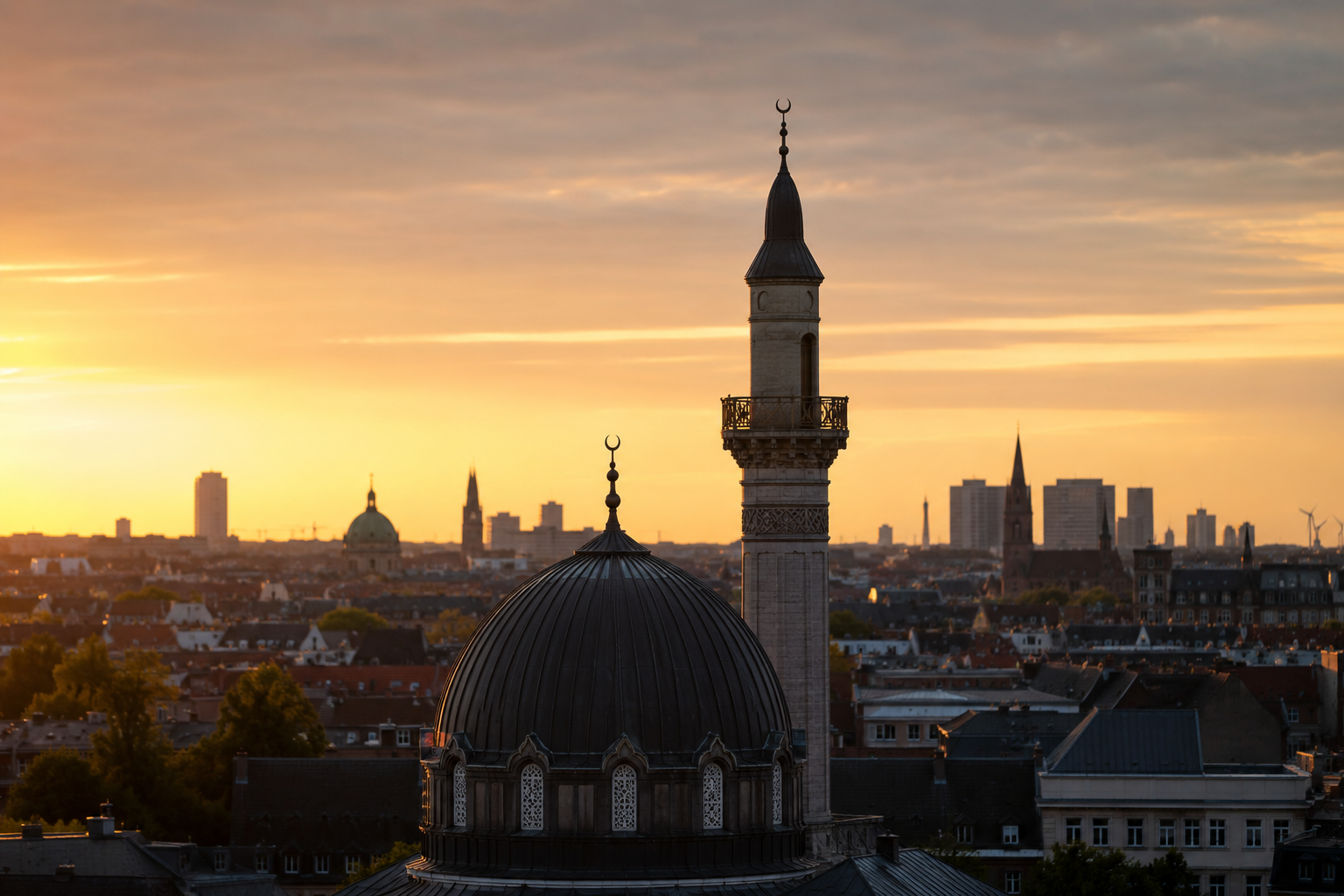
Denmark has revived plans to ban the Islamic call to prayer, the Adhan, from being broadcast in public across the country. Immigration Minister Morten Bodskov confirmed the government will reopen an investigation into whether the amplified call can be legally prohibited nationwide, telling Danish news agency Ritzau that “the call to prayer should not be heard over Danish rooftops.”
The announcement reignites a long-running national debate over immigration, integration, and the public expression of religion in one of Europe’s most closely watched countries on these issues.
A Third Attempt
This is not the first time Danish lawmakers have explored restricting the Adhan. Similar efforts surfaced in 2020 and again in 2025, but neither advanced to the parliamentary stage. The current push marks a third attempt to establish a legal framework for a ban, and the government has signaled it intends to find a path where earlier proposals stalled.
The Adhan is the traditional Islamic call to prayer, recited five times a day to summon worshippers. In many Muslim-majority countries it is broadcast publicly over loudspeakers from mosque minarets. In much of Europe, the practice is far less common and is often governed by local noise and zoning rules rather than national law.
What the Proposal Would Change
In practice, the public broadcast of the Adhan is already limited in parts of Denmark. Certain areas, including sections of Copenhagen, restrict amplified outdoor sound under existing noise regulations. The capital’s Grand Mosque operates under an arrangement with local authorities in which it does not broadcast an outdoor call to prayer.
What the government is now weighing is different in scope: a single, nationwide prohibition rather than a patchwork of local rules. Extending restrictions to the entire country would represent a significant legal step, and ministers have framed the reopened investigation as the first stage in determining whether such a ban is even possible under Danish law.
The Constitutional Hurdle
Any blanket ban faces a substantial obstacle. Denmark’s Constitution protects the right to public worship, and legal experts expect that a nationwide prohibition on a religious practice would draw immediate constitutional challenges. That sets up a potential clash between the government’s stated goal and the country’s own founding document.
Because the broadcast call to prayer is so rare in Denmark to begin with, supporters and critics alike acknowledge that the measure is as much symbolic as it is practical. The question of whether the state can single out one religious practice for restriction without running afoul of constitutional protections is likely to dominate the legal discussion ahead.
Two Sides of the Debate
Supporters of the government’s position frame the move as a question of public sound, neighborhood quiet, and integration. They argue that the policy reflects long-standing Danish norms about religion in public life and the management of shared urban space.
Critics counter that a targeted ban amounts to a restriction on religious freedom that singles out one faith, and that existing noise rules already address any practical concerns about volume. They warn that codifying a national prohibition could deepen divisions and send a message about whose worship is welcome in public.
Why It Matters
For readers far from Copenhagen, the story is a window into a debate playing out across much of Europe: how democracies balance religious freedom, integration, and the rules that govern shared public space. How Denmark resolves the tension between a proposed ban and its constitutional protection of worship could shape similar conversations elsewhere.
For now, the proposal is at the investigation stage, and any legislation would still have to clear both political and legal tests. The debate, however, is squarely back in the national spotlight.
Stay informed on the stories that matter most. Follow Palmedia News on Facebook and bookmark palmedianews.com for breaking news and analysis.