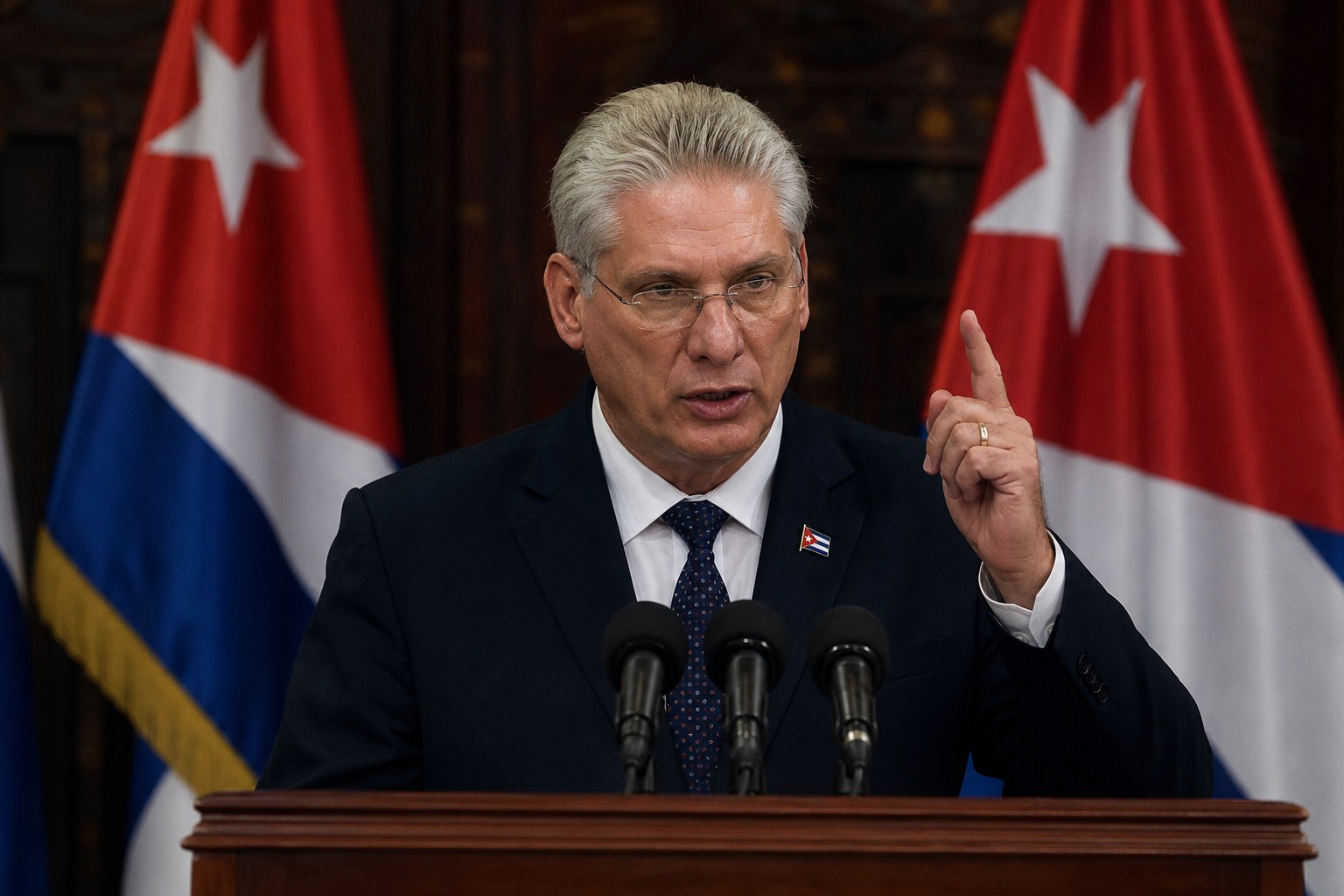
Cuba’s President Miguel Díaz-Canel has accused the United States of committing “genocide” against the Cuban people and charged that the Trump administration is actively working to seize control of the island. The remarks, delivered this week, rank among the most forceful denunciations Havana has directed at Washington in years, and they have sharply escalated tensions between the two long-standing adversaries.
Six Decades of Hostility
The confrontation between Havana and Washington is not new. The U.S. economic embargo on Cuba, first imposed in the early 1960s, remains the longest-running trade restriction of its kind in modern history. For more than sixty years it has shaped nearly every aspect of Cuban life, limiting trade, finance, and travel.
Successive Cuban governments have blamed the embargo — which they call “the blockade” — for the island’s chronic economic struggles. Washington, in turn, has maintained that the sanctions are a response to the Cuban government’s political system and human rights record, not an effort to punish ordinary citizens.
What Díaz-Canel Said
In his public remarks, Díaz-Canel described U.S. policy as a deliberate campaign designed to strangle Cuba’s economy and pressure its population into submission. He framed the tightening of sanctions and renewed restrictions under the Trump administration as evidence of an ambition that goes beyond an ordinary policy dispute — an effort, in his words, to take control of the island outright.
The Cuban leader’s use of the word “genocide” was pointed. It is a term loaded with legal and moral weight, and Havana has increasingly deployed it to describe the cumulative human cost of the embargo. Díaz-Canel argued that the sustained economic pressure amounts to a policy aimed at making life unlivable for millions of Cubans.
He also tied the accusations directly to President Trump, casting recent moves by Washington as proof of a broader takeover strategy rather than a set of isolated measures.
Washington Pushes Back
U.S. officials have consistently rejected accusations of this kind. The American position holds that sanctions target the Cuban government and its policies, not the Cuban people, and that responsibility for the island’s shortages lies with Havana’s own economic management.
Critics of the Cuban government echo that view, arguing that decades of centralized control, limited private enterprise, and chronic mismanagement have done more damage to the economy than any external sanction. Supporters of Havana counter that no economy could function normally under the weight of the longest embargo in modern history. The dispute over who bears responsibility — Washington or Havana — is now decades old, and Díaz-Canel’s latest comments show no sign that either side is prepared to soften its stance.
A Nation Under Strain
The accusations come at a moment of acute hardship inside Cuba. The island has been gripped by severe shortages of food, fuel, and medicine, and repeated power outages have disrupted daily life. Record numbers of Cubans have left the country in recent years, seeking stability and opportunity abroad.
Against that backdrop, the rhetoric from Havana carries added urgency. For a government facing mounting domestic pressure, framing the crisis as the product of foreign hostility serves both as an explanation and as a rallying point.
Why It Matters
For Americans, the standoff is a reminder that one of the oldest disputes in the Western Hemisphere remains unresolved. U.S.-Cuba policy touches on immigration, trade, and regional diplomacy, and shifts in that relationship can ripple across Florida, the Caribbean, and beyond. As the war of words intensifies, the prospect of any near-term thaw appears increasingly remote.
Stay informed on the stories that matter most. Follow Palmedia News on Facebook and bookmark palmedianews.com for breaking news and analysis.