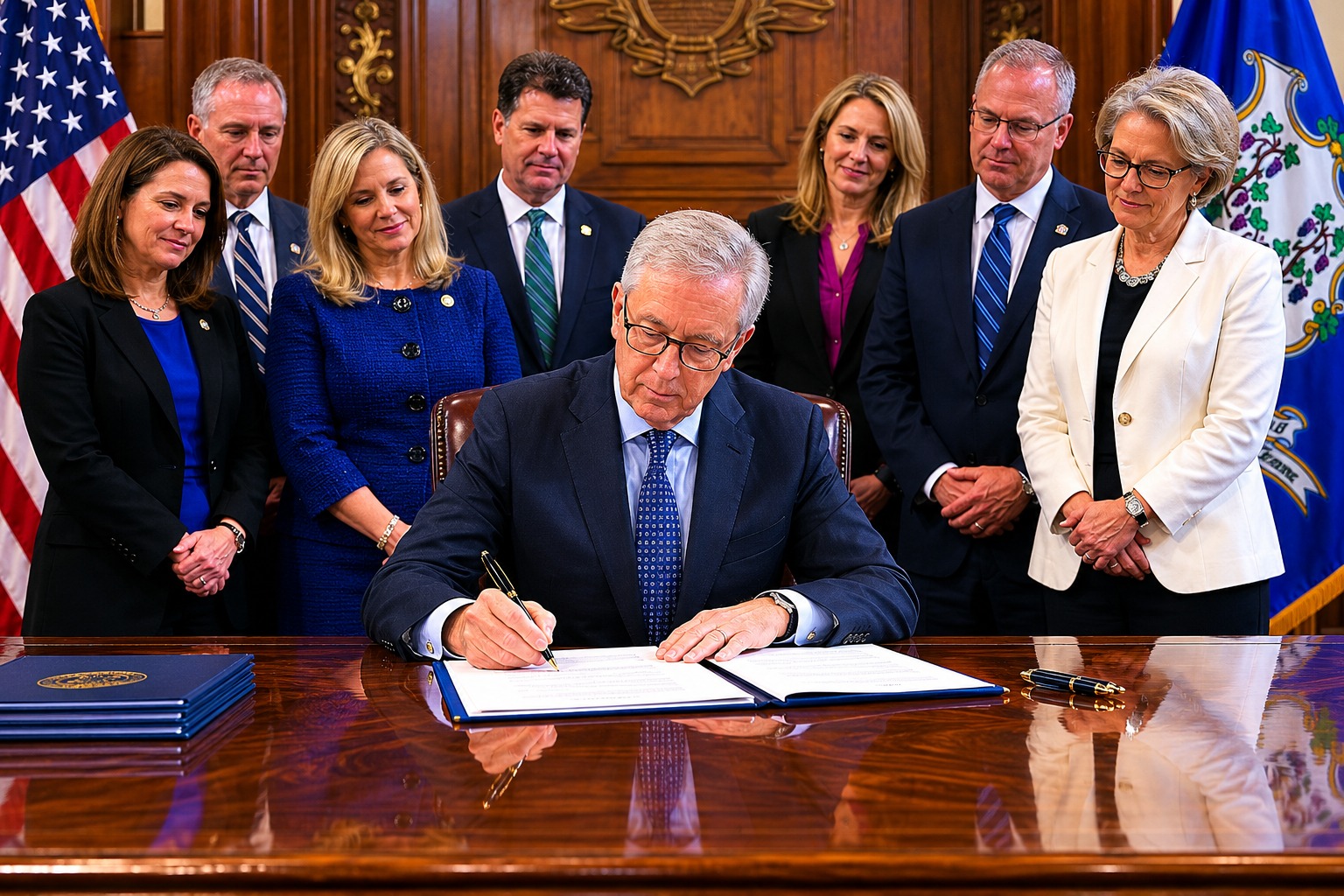
Connecticut has enacted one of the most aggressive state-level limits on federal immigration enforcement in the country. Governor Ned Lamont signed Senate Bill 397 into law, a sweeping measure that bars Immigration and Customs Enforcement agents from making warrantless arrests inside schools, churches, hospitals, and courthouses. The move sets up a direct test of how far a single state can go to restrict the reach of federal agents operating within its borders.
What the Law Actually Does
Titled “An Act Concerning Democracy and Government Accountability,” SB 397 is far broader than a simple list of off-limits locations. At its core, it prohibits immigration enforcement agents from carrying out warrantless arrests in a defined set of protected places. The section establishing those restrictions is scheduled to take effect in October, giving agencies and institutions a window to adjust before the rules are active.
But the protected-location provision is only one piece. The law also creates a new legal avenue for individuals who believe their rights were violated during an enforcement action, allowing them to sue the agents involved. That provision alone marks a significant shift, opening the door to civil accountability that has rarely existed in the immigration enforcement context.
Transparency and Identification Requirements
SB 397 reaches beyond arrests and into how enforcement looks on the ground. Under the new rules, federal, state, and local officers will be required to show their faces and wear badges or name tags while conducting enforcement actions. Most officers will be banned from wearing masks when interacting with the public, a response to growing concern over unidentified agents operating in communities.
The law also restricts how ICE can use data collected from automated license plate readers, limiting a surveillance tool that has expanded rapidly in recent years. And to keep the public informed, the state will build a public dashboard to track immigration enforcement activity across Connecticut, an unusual layer of transparency for operations that typically happen out of public view.
Supporters and Critics Square Off
Supporters of the law describe it as a matter of accountability and protection for vulnerable communities, arguing that schools, hospitals, and houses of worship should remain places where people can seek help without fear. They frame the badge, mask, and transparency requirements as common-sense safeguards that simply ask agents to identify themselves.
Critics see it very differently. They argue the measure amounts to state interference with federal law and could set up a legal collision with Washington. The possibility of a courtroom showdown is real, and Connecticut joins only a small group of states that have moved this far to limit federal immigration agents inside their own jurisdictions.
What This Means for Americans
For residents of Connecticut, the law changes the rules around some of the most sensitive places in daily life, from a child’s classroom to a hospital emergency room. For the rest of the country, it is a preview of a deepening fight over who controls immigration enforcement, and how far states can push back against federal authority. The outcome of any legal challenge could shape that balance well beyond Connecticut’s borders.
Stay informed on the stories that matter most. Follow Palmedia News on Facebook and bookmark palmedianews.com for breaking news and analysis.