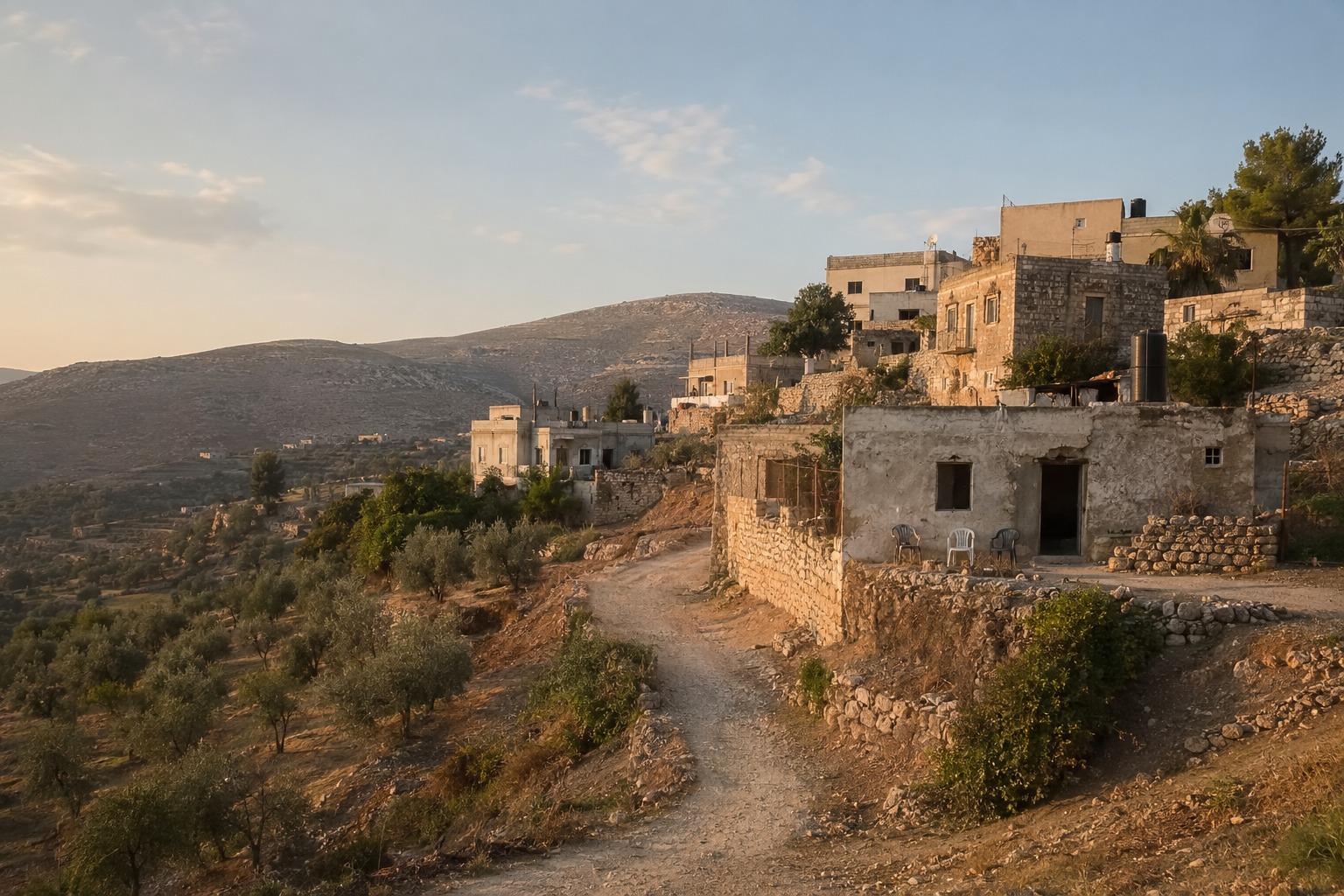
Amnesty International has accused the Israeli government of carrying out a campaign of “ethnic cleansing” against Palestinians in the occupied West Bank, laying out the claim in a new 149-page report that the rights group says documents a coordinated, state-backed effort to push communities off their land.
The accusation, among the most serious a human rights organization can level, frames the displacement of West Bank Palestinians not as isolated incidents but as the result of deliberate policy. The Israeli government rejects the characterization, maintaining that its actions in the territory are tied to security and the enforcement of the law.
What Amnesty Says It Found
According to Amnesty, the report draws on interviews with displaced Palestinians, lawyers, and witnesses, alongside a review of more than 420 videos and an analysis of official government statements. Researchers focused on 27 hamlets and villages across the West Bank where, by the group’s count, roughly 5,910 people were forced from their homes between January 2023 and December 2025.
Amnesty’s Secretary General, Agnès Callamard, placed settler violence at the center of the findings, describing it as “a core component of a state-sanctioned campaign.” The organization argues that the violence and displacement it documented are not simply the work of individual settlers acting on their own, but part of a broader strategy aimed at annexing Palestinian territory. The group is calling on the international community to take action to halt West Bank annexation.
The Wider Context
The West Bank has been under Israeli military occupation since 1967, and the status of its land, settlements, and Palestinian residents sits at the heart of one of the world’s most enduring and contested disputes. International bodies and rights groups have long tracked demolitions, settlement expansion, and the displacement of Palestinian communities, while Israel has consistently defended its presence and policies in the territory on legal and security grounds.
The numbers extend beyond Amnesty’s own count. The United Nations has separately tracked more than 7,280 instances of Palestinian displacement linked to the demolition of homes and structures over a similar period. The anti-settlement monitoring group Peace Now, meanwhile, has reported a sharp rise in West Bank outposts since 2023 — a trend critics say signals accelerating expansion and supporters describe as legitimate development.
Israel’s Response
The Israeli government has firmly and repeatedly rejected accusations of ethnic cleansing. Officials have argued that operations in the West Bank are driven by security needs and the enforcement of building and zoning law, not by an intent to remove Palestinians. In the past, Israeli authorities have dismissed similar Amnesty reports as biased, questioning both the group’s methodology and its conclusions.
That sharp disagreement — over the facts on the ground, the language used to describe them, and the intent behind specific policies — is precisely what makes the report so contentious. Where Amnesty sees a deliberate campaign, the Israeli government sees lawful administration of a disputed territory.
Why It Matters
Reports like this one rarely stay confined to the region they describe. They shape debates in capitals around the world, influence diplomatic pressure, and feed into ongoing arguments over aid, trade, and international law. For readers far from the West Bank, the report is a window into a conflict whose outcomes ripple through global politics, alliances, and humanitarian policy — and a reminder of how much disagreement remains over even the most basic terms used to describe it.
Stay informed on the stories that matter most. Follow Palmedia News on Facebook and bookmark palmedianews.com for breaking news and analysis.