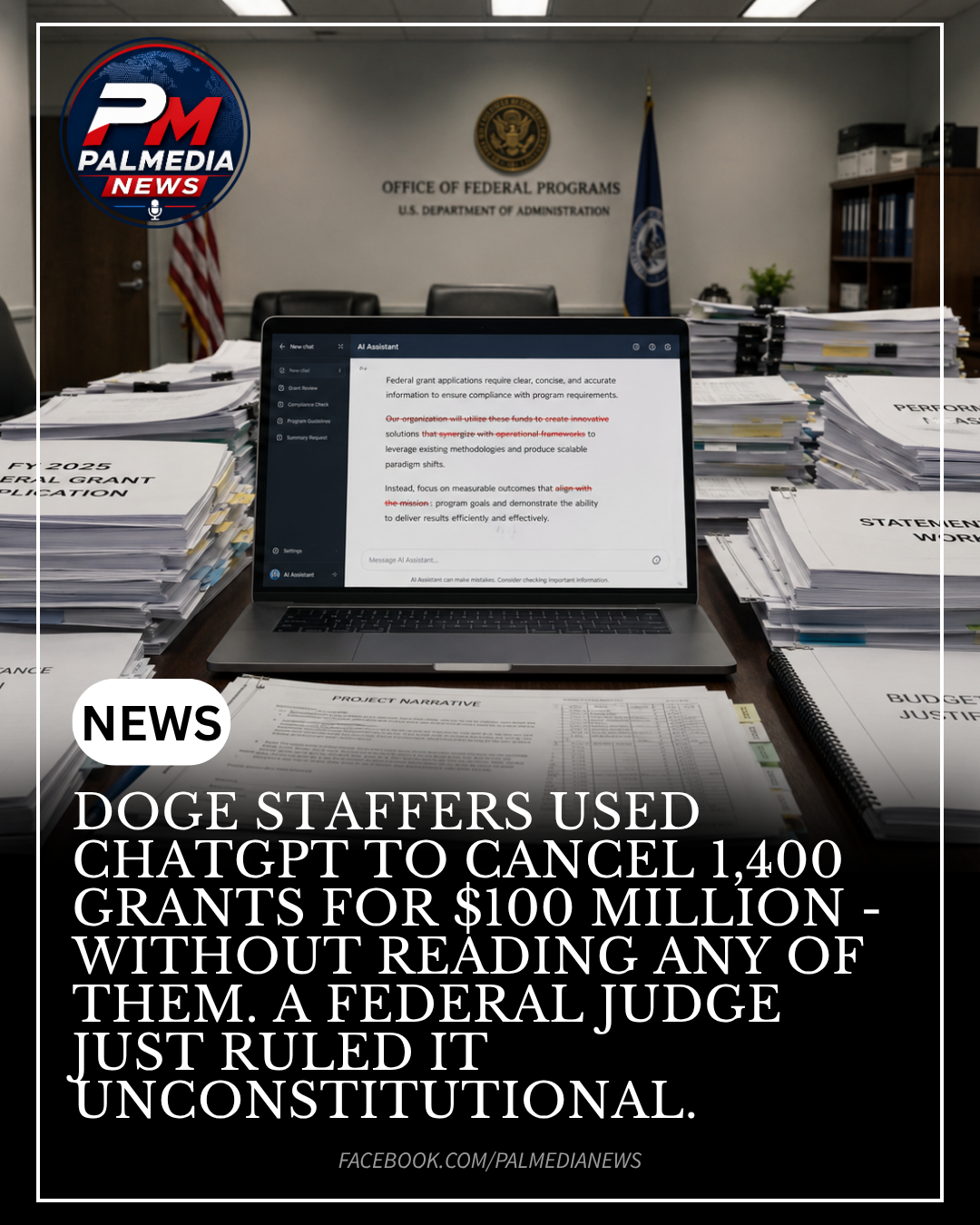
The Department of Government Efficiency didn’t read the grants. It didn’t need to — it had ChatGPT.
According to court documents, DOGE staffers fed thousands of federal grant applications into the AI chatbot, letting the tool scan for keywords and decide which ones to flag for immediate cancellation. When the AI flagged a grant, staffers canceled it. No human review. No policy analysis. No oversight. Just a chatbot making federal funding decisions worth $100 million.
The process targeted approximately 1,400 grants across multiple federal agencies. The AI was reportedly instructed to scan for terms associated with diversity, equity, and inclusion initiatives, climate research, and other programs the administration had targeted for elimination. If a grant included the right keywords, it was gone — regardless of what the grant actually funded, who it served, or whether the cancellation was legally authorized.
What ChatGPT swept up in that process turned out to include cancer research grants, mental health studies, rural health programs, and university research partnerships that had nothing to do with the political targets the administration was aiming for. Researchers who’d been awarded the grants received termination notices with no explanation — just a notification that their funding no longer existed. No appeals process. No review. Just an automated cancellation generated by a machine that had never seen the actual work the money was supposed to fund.
The legal challenge came quickly. Plaintiffs argued that the cancellations violated the Impoundment Control Act and the separation of powers — that the executive branch had no authority to unilaterally terminate congressionally appropriated funding, particularly not through an automated review process that bypassed the statutory requirements attached to each grant program. Federal agencies don’t get to ignore the laws governing how they award and terminate grants just because they’ve built a faster system for doing it.
A federal judge agreed. The court found the mass cancellations unconstitutional, ruling that the executive branch cannot unilaterally terminate congressionally appropriated grants using an AI tool as a surrogate reviewer. The decision struck down the cancellations and ordered a review — a significant legal rebuke to the DOGE team’s approach to cutting federal spending.
The ruling adds to a growing legal record of courts pushing back on DOGE’s methods. Since the department began its aggressive push to eliminate federal programs, judges have repeatedly found that the speed of the cuts doesn’t exempt them from legal constraints. Congress appropriates money through a deliberate process with specific requirements. The executive branch can’t skip those requirements by feeding grant applications into a chatbot and treating the output as a binding decision.
The administration has maintained that streamlining government spending is within its authority and that eliminating duplicative or ideologically driven programs is a legitimate exercise of executive power. Critics argue that using AI to make funding decisions without human review is exactly the kind of unchecked executive action the courts exist to stop — and that the collateral damage to unrelated research programs demonstrates why automated keyword-scanning is an inadequate substitute for actual policy review.
For now, the judge agreed. The 1,400 grants are subject to review, the cancellations have been struck down, and the administration faces the harder question of whether it can rebuild a legally defensible process for cutting programs it has already decided to eliminate. The answer to that question is still being written — but the current approach has now been ruled unconstitutional.