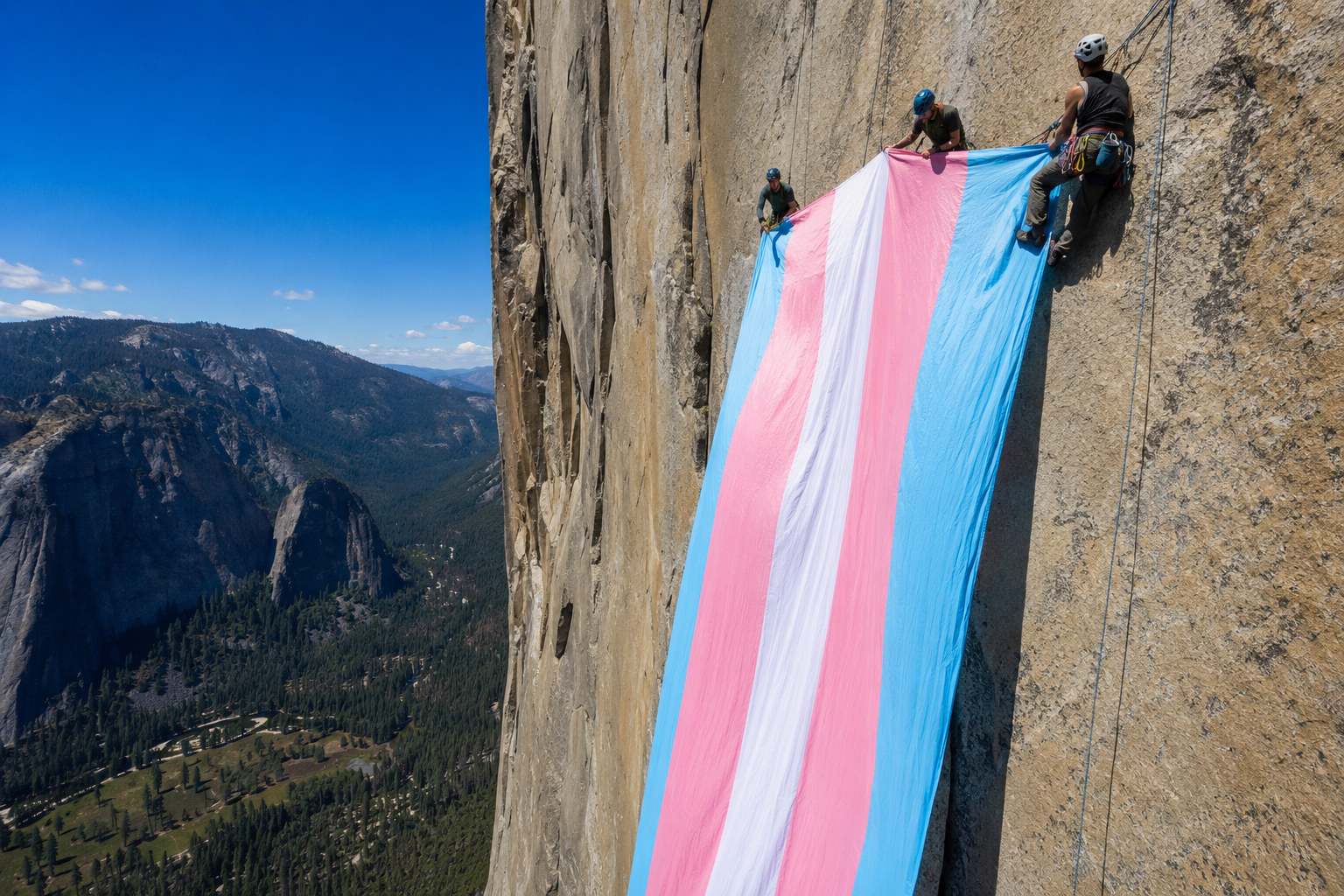
A federal judge has dismissed the lawsuit brought by a former Yosemite National Park ranger who was fired after helping fly a giant transgender pride flag from El Capitan, the towering granite wall that looms over the park’s main valley. The ruling, handed down June 12, sends the dispute out of federal court and back into the federal employment review system.
U.S. District Judge Jennifer Thurston dismissed the case filed by Shannon “SJ” Joslin, who is nonbinary and uses they/them pronouns. The judge found that because Joslin was still a probationary employee at the time of the firing, they must pursue the complaint through the Office of Special Counsel under the Civil Service Reform Act rather than going straight to a federal courtroom.
How the Flag Ended Up on El Capitan
The story began on May 20, 2025, when Joslin says they helped unfurl a 66-foot-wide transgender pride flag down the sheer face of El Capitan. The flag hung for roughly two hours before the group took it down voluntarily. Joslin has emphasized two points repeatedly: the display happened on a day off, not while they were on duty, and it was meant as a message of inclusion. Hanging the flag, Joslin told reporters, was a way of saying “We’re all safe in national parks.”
El Capitan sits inside Yosemite Valley, an area that includes designated “First Amendment areas” where small groups can demonstrate without a permit. That detail became central to the legal fight, with Joslin arguing the act was protected expression carried out as a private citizen.
In August 2025, Joslin received a termination letter accusing them of failing to display appropriate conduct, with the flag incident cited as the reason. The firing set off the legal battle that has now reached its first major turning point.
What the Lawsuit Claimed
Joslin’s lawsuit named the National Park Service, the Department of the Interior, and other defendants, alleging the firing amounted to retaliation that violated their First Amendment right to free speech. The core argument was straightforward: a government employee was punished for a personal act of expression conducted off the clock.
The judge’s dismissal did not rule on whether the firing was right or wrong. Instead, it turned on a procedural question — which forum is allowed to hear the dispute. Because probationary federal workers fall under a specific complaint process, the court determined Joslin must first exhaust the administrative channel through the Office of Special Counsel before any court can weigh in. According to court documents, that office had already denied Joslin’s initial request to delay the termination while it investigated whether the Park Service broke the law.
A New Rule the Very Next Day
One detail has drawn particular attention. The day after the flag came down, Yosemite implemented a new rule banning any banner, flag, or sign larger than 15 square feet in areas designated as wilderness or potential wilderness. Supporters of Joslin point to the timing as evidence the display struck a nerve; park officials frame such rules as routine management of protected landscapes.
The Debate It Reignited
The case has split observers along familiar lines. One side sees a public servant disciplined for a peaceful, off-duty act of expression — a free-speech question with implications for every federal worker. The other side sees an employee who used a national landmark for a personal statement and argues that parks must enforce neutral rules consistently, regardless of the message involved.
It is not the first time El Capitan has become a backdrop for protest. Earlier in 2025, demonstrators hung an upside-down American flag on the same wall to protest staffing cuts at the National Park Service. The granite icon, visible to nearly everyone who drives into the valley, has proven to be an irresistible canvas for those seeking attention for a cause.
What This Means Going Forward
For now, the dismissal does not end Joslin’s fight. Their complaint continues to move through the Office of Special Counsel, the body that handles allegations of improper firings of federal employees. A future ruling there could still reopen questions about whether the termination was lawful. For the rest of the country, the case is a reminder of how blurry the line can be between a government employee’s private speech and their public role — and how that line tends to get tested at the places Americans hold most iconic.
Stay informed on the stories that matter most. Follow Palmedia News on Facebook and bookmark palmedianews.com for breaking news and analysis.