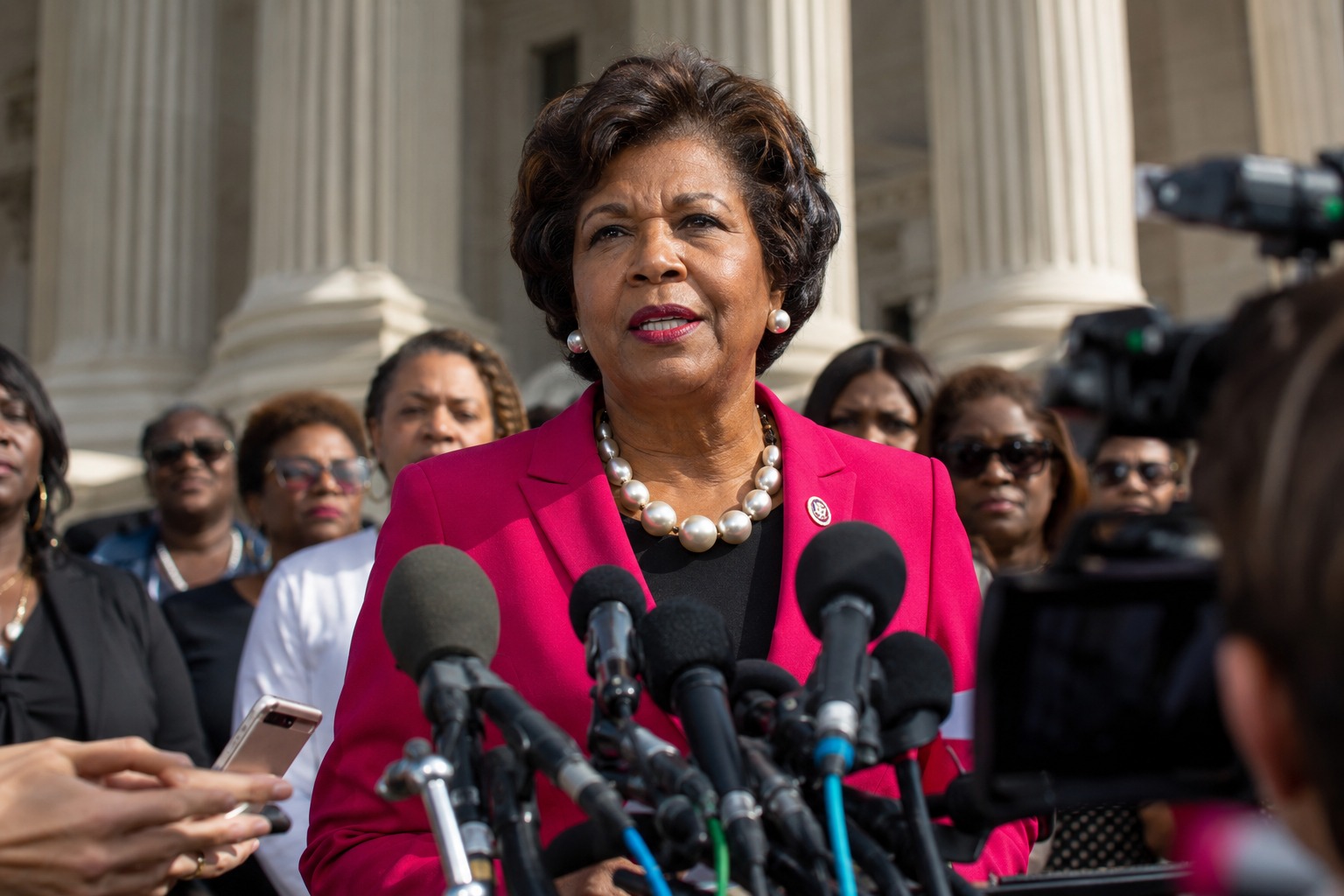
A federal judge has ordered President Donald Trump’s name removed from the John F. Kennedy Center for the Performing Arts, handing Congresswoman Joyce Beatty a landmark courtroom victory and reaffirming that the nation’s living memorial to John F. Kennedy belongs to the public — not to any single president.
In a ruling issued Friday, U.S. District Judge Christopher Cooper found that the attempt to rename the federally chartered institution violated the law that created it. His conclusion was direct: “Congress gave the Kennedy Center its name, and only Congress can change it.”
Why This Case Matters
The Kennedy Center is not an ordinary building. It was established by an act of Congress as the official national memorial to President John F. Kennedy, and its governance, name, and mission are defined in federal statute. That legal status is precisely what put the renaming effort on a collision course with the courts. When a memorial is created by law, the people’s elected representatives — not the executive branch acting alone — hold the power to alter what it stands for.
That distinction sits at the heart of the dispute. The lawsuit argued that stripping Kennedy’s name and rebranding the center exceeded the authority of any administration, no matter who occupies the White House. The court agreed, treating the case less as a partisan fight and more as a question of who controls a public institution that Congress expressly set aside to honor a former president.
What the Court Ordered
The decision came in a lawsuit brought by Rep. Joyce Beatty, the Ohio Democrat who serves as an ex officio member of the Kennedy Center’s Board of Trustees by virtue of her seat in Congress. She contended that the administration had no legal authority either to rename the memorial or to shut it down.
Judge Cooper sided with her on both points. Under the ruling, the defendants have 14 days to remove all signage bearing Trump’s name from the building, to correct the center’s website, and to withdraw every pending trademark application tied to the name “Trump Kennedy Center.” They must then file sworn proof with the court that each step has been completed.
The judge went further, separately blocking a planned wind-down of the center’s programming and its scheduled closure on July 5. That portion of the order kept the doors open and the performances running while the broader legal questions are settled — a practical victory for the artists, staff, and audiences who depend on the institution.
Reactions and What Comes Next
Beatty framed the outcome as a win for the country rather than for any party, saying the memorial “belongs to the American people.” Supporters quickly cast her as the lawmaker who safeguarded the Kennedy Center’s legacy, pointing to the ruling as a defense of the principle that national landmarks are held in trust for the public.
Critics counter that the matter is far from finished. They argue the legal battle could continue on appeal, and that higher courts may yet weigh in on the limits of executive authority over a congressionally created institution. For now, though, the trial court’s order stands, and the clock on that 14-day compliance window is already running.
What This Means for Americans
Beyond the headlines, the ruling speaks to a question that touches every citizen: who gets to decide what public institutions stand for. The Kennedy Center hosts performances, education programs, and national ceremonies that draw millions. The court’s decision signals that the names and missions of such places — when set by law — cannot be rewritten at will, but only through the same democratic process that created them in the first place.
Stay informed on the stories that matter most. Follow Palmedia News on Facebook and bookmark palmedianews.com for breaking news and analysis.