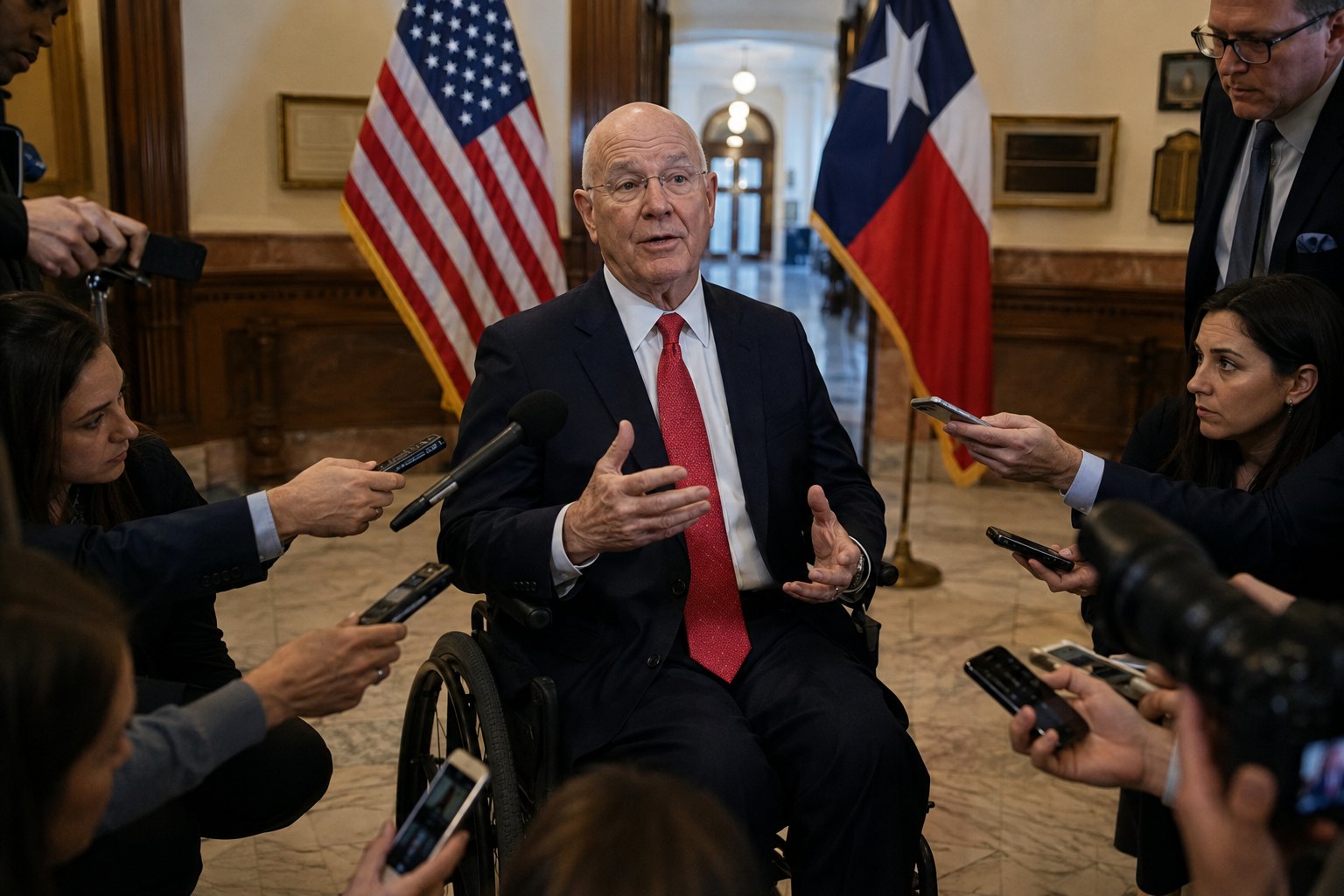
Texas has not elected a Democrat to statewide office since 1994. Heading into the 2026 midterms, the race for one of its U.S. Senate seats is now a statistical tie — and Gov. Greg Abbott says Republicans have nothing to worry about.
Asked about mounting GOP anxiety over the state, Abbott called the choice between Democrat James Talarico and Republican Ken Paxton “easy,” predicting voters will break decisively toward Paxton once they learn more about Talarico’s record — a record Abbott described as “crazy.”
A Race That Was Never Supposed to Be Close
For three decades, statewide races in Texas have followed a familiar script: Republicans win, sometimes narrowly, but they win. That assumption is under real strain this cycle.
A new Emerson College poll of Texas likely voters puts Paxton at 47 percent and Talarico at 46 percent — a one-point margin that sits comfortably inside the survey’s margin of error. A separate Texas Pulse survey conducted in late July went further, showing Talarico ahead by two points. Taken together, the numbers describe a contest that is effectively tied.
The nonpartisan Cook Political Report has already responded to the shift, moving the Texas Senate contest from Lean Republican to Toss-Up. That reclassification matters: it changes how national party committees allocate money, where outside groups spend, and how seriously each campaign is treated by donors.
How the Two Candidates Got Here
Talarico, a state representative, won the Democratic nomination earlier this year. Paxton, the state’s attorney general, emerged from a bruising Republican primary fight that divided the party rather than unifying it behind a single standard-bearer.
Since then, the two campaigns have taken markedly different approaches. Talarico has flooded Texas airwaves with advertising, spending aggressively to define himself before his opponent can. Paxton and much of the state Republican apparatus have stayed comparatively quiet, a contrast that has not gone unnoticed by strategists in both parties.
That spending gap is one reason the polling has tightened. In a state as large and as expensive to advertise in as Texas, sustained early presence on television and digital platforms can move numbers well before Election Day.
Not Every Republican Shares Abbott’s Confidence
Abbott’s public calm is not universal within his party. Sen. Ted Cruz — who has survived a competitive statewide race of his own — told Abbott during a July radio appearance that Talarico has “a real chance” to win the seat.
Pollsters tracking the state have offered similar cautions, noting that even in a reliably red state, the current environment points to a difficult election year for Republicans. Abbott, for his part, has not adjusted his message, continuing to frame the choice as a straightforward one that will resolve itself once voters focus on the contrast.
Abbott Has His Own Race to Run
The governor is not a bystander in this cycle. The same Emerson poll shows Abbott leading his Democratic challenger by four points — a comfortable lead in isolation, but a narrow one for a governor who won his last election by roughly 11 points.
That compression at the top of the ticket is part of what has Republicans watching Texas more closely than they have in years. When the governor’s margin shrinks and the Senate race ties, the question stops being about any single candidate and starts being about the state itself.
What This Means for Texans
A competitive statewide race changes what voters experience. Expect far more advertising, more candidate visits to places that are usually skipped, and more attention paid to local concerns that normally get lost in a foregone conclusion. Turnout operations on both sides will be substantially better funded than in a typical Texas cycle.
It also raises the stakes for the U.S. Senate as a whole. A seat that neither national party budgeted as competitive is now one that both must contest, which reshapes spending decisions in races hundreds of miles away.
Whether Abbott’s read proves correct will not be settled by polling in August. But the gap between his confidence and his party’s unease is now one of the defining storylines of the 2026 map.
Stay informed on the stories that matter most. Follow Palmedia News on Facebook and bookmark palmedianews.com for breaking news and analysis.