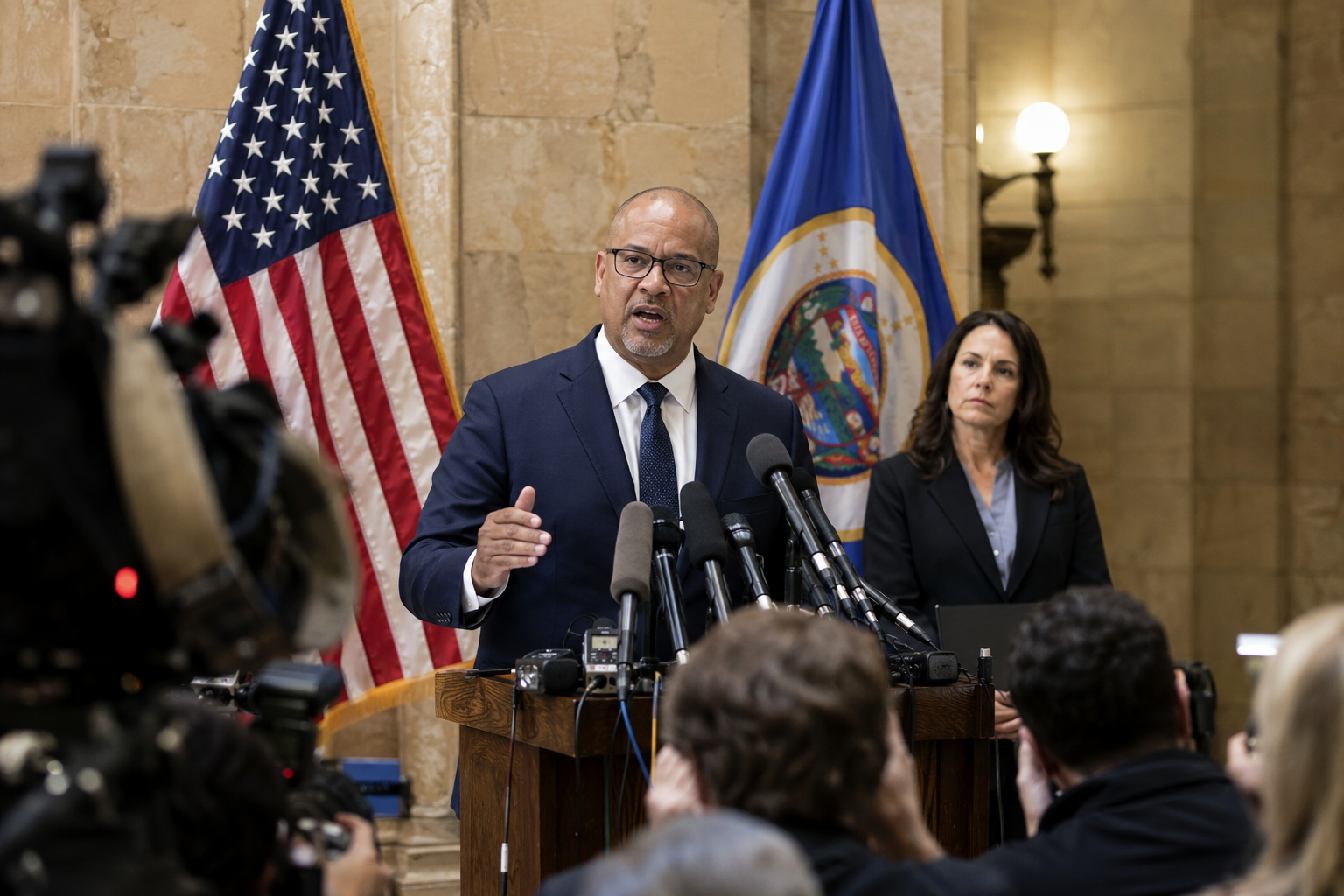
Minnesota’s top prosecutor has taken the extraordinary step of suing another state’s governor. Attorney General Keith Ellison filed suit against Texas Governor Greg Abbott this week, asking a court to force Abbott to hand over a federal immigration officer charged with firing a gun through the front door of an occupied Minneapolis home.
Hennepin County Attorney Mary Moriarty joined the action. Both said the refusal is close to unheard of in modern practice between states.
The Shooting That Started It
The case dates to January 14. Prosecutors say Christian Castro, an agent with Immigration and Customs Enforcement, fired a weapon at the front door of an occupied home in Minneapolis. A Venezuelan man inside was struck in the leg. Prosecutors allege Castro then gave an account of what happened that did not match the evidence.
He was charged in Minnesota with four counts of second-degree assault and one count of falsely reporting a crime. The charges are state charges, brought under Minnesota law, in a Minnesota court — a detail that sits at the center of everything that followed.
Arrested in Texas, and Then Stuck There
Castro did not remain in Minnesota. Texas Rangers located and arrested him on May 29. A judge in Cameron County ordered him detained while extradition proceedings moved forward, which is the normal path: one state asks, the other sends the person back to face trial.
The final step is a document called a rendition warrant. The governor of the state holding the person signs it, directing law enforcement to transfer custody. Abbott has not signed it. Ellison says he contacted Abbott directly and gave him until the end of the day Monday to approve the transfer, warning that Minnesota would go to court otherwise. Abbott did not sign, and the lawsuit followed.
Why Extradition Almost Never Becomes a Fight
Moving a defendant from one state to another is usually paperwork, not a decision. The framework is old and deliberately narrow, built on the premise that a person charged in one state should not escape trial simply by crossing a state line. Governors sign these warrants routinely, often without the public ever hearing about it.
That is what makes this unusual. Ellison and Moriarty have both described an outright refusal as extremely rare, and possibly without precedent in a case like this one. With no signature, Castro could be released in Texas — and never appear in a Minnesota courtroom at all.
The Bigger Question Underneath
The standoff is about one agent, but the argument reaches much further. It touches whether a federal officer can be prosecuted by a state for conduct carried out on duty, and whether another state’s governor can effectively decide that question by declining to act.
Supporters of Abbott’s position argue that federal agents enforcing federal law should not be exposed to prosecution by individual states. Minnesota’s position is narrower and procedural: the charges exist, a court accepted them, and extradition is not the stage where the merits get decided. Guilt or innocence, in that view, is for a jury — after the transfer, not instead of it.
What This Means for Americans
Most people will never think about a rendition warrant. But the system it belongs to is what keeps state lines from functioning as a barrier to accountability. If a governor can decline to send someone back over a disagreement about the underlying case, the practical reach of every state’s criminal courts narrows — regardless of who is charged, or which state is asking. That is why a dispute over a single signature has drawn attention well beyond Minnesota and Texas.
For now, the case sits with the courts, and Castro remains in Texas.
Stay informed on the stories that matter most. Follow Palmedia News on Facebook and bookmark palmedianews.com for breaking news and analysis.