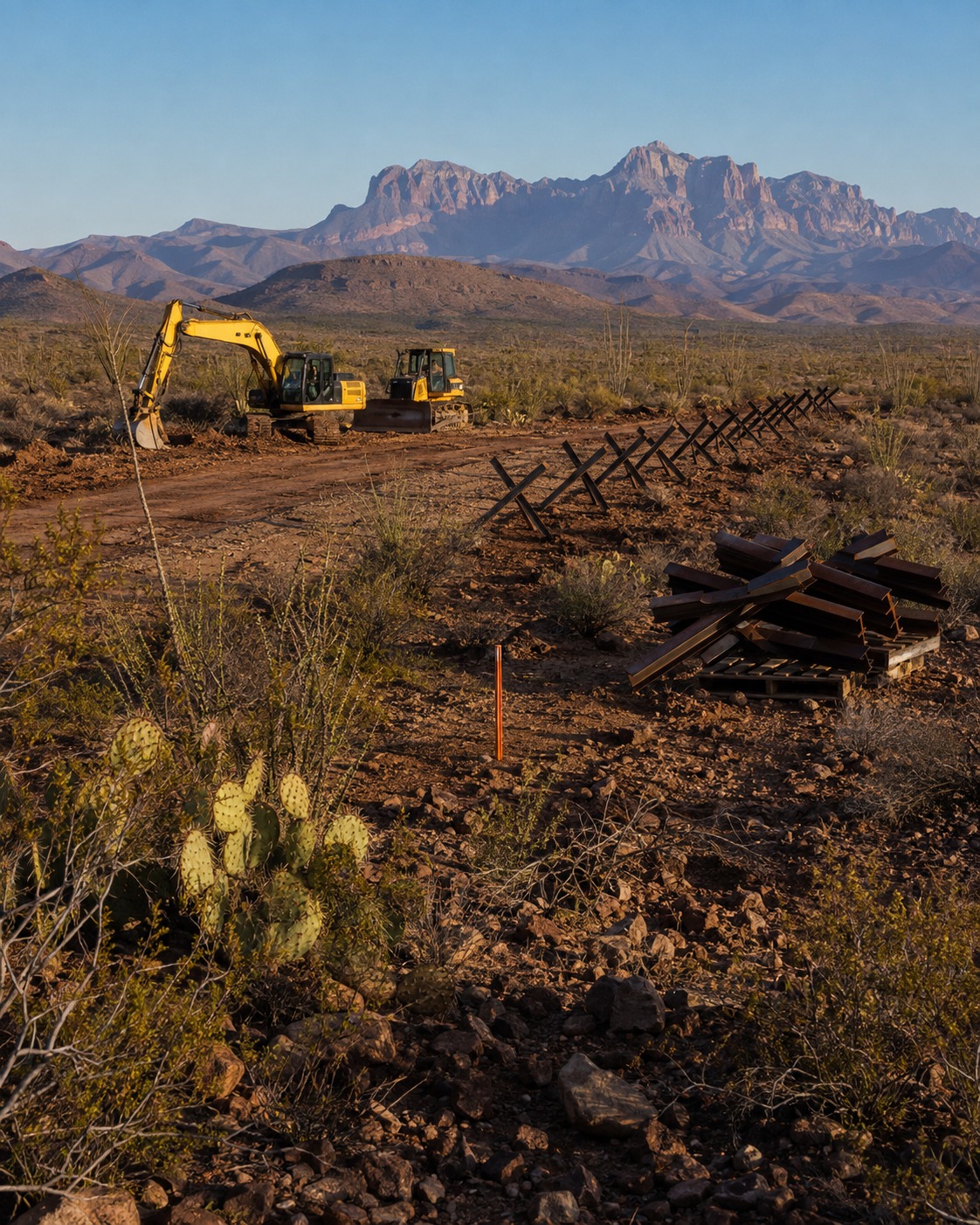
Every piece of border barrier construction inside Big Bend National Park has been stopped. U.S. Customs and Border Protection Commissioner Rodney Scott announced Monday that he ordered a pause on all construction activity in the West Texas park so he can travel to the site himself, walk the ground, and hear directly from stakeholders and local law enforcement before any more steel goes up.
Why Big Bend Is Different
Big Bend is not an ordinary stretch of the southern border. The park covers more than 800,000 acres of Chihuahuan Desert, and the Rio Grande itself forms the international boundary there, cutting through limestone canyons that rise hundreds of feet above the water. It is one of the most remote and least developed places in the continental United States, and one of the darkest night skies in North America.
That geography is exactly why the project drew objections. Critics have argued that the river and its canyon walls already function as a natural barrier, and that building through protected federal parkland trades a small enforcement gain for permanent damage to terrain that cannot be put back.
What Was Actually Being Built
The project had already been scaled back once. Rather than the administration’s standard 30-foot steel bollard fence seen elsewhere along the border, the plan called for roughly 17 miles of vehicle barriers — interconnected steel X-shaped structures standing only about four to six feet tall.
Those barriers were to be paired with a wider surveillance package: cameras, lighting, ground sensors, and a new patrol road running through the park. For many of the project’s critics, the road drew as much concern as the barrier. Roads bring traffic, dust, and permanence to land that had none of it.
The Opposition Was Bipartisan
What separates this fight from most border disputes is who lined up against it. The opposition did not split along party lines. Republican and Democratic sheriffs in the region raised objections together. Former national park officials warned publicly that the work was being rushed. Local residents whose livelihoods depend on park tourism — outfitters, river guides, lodge and restaurant owners — spoke out, and several Texas elected officials joined them.
Scott said he wanted to see the site in person and talk to those stakeholders before construction continues. He has not said how long the pause will last, and the administration has not canceled the project. For now, the equipment sits idle.
What Happens Next
A pause is not a reversal. Everything about the project — the 17 miles of barriers, the patrol road, the surveillance network — remains on the table, and the commissioner retains the authority to restart the work after his visit. What changed is that the decision now runs through a personal site evaluation rather than a construction schedule set from Washington.
The broader question the pause raises has not been answered: whether physical barriers belong inside national parks at all, and who gets a say when federal land, border policy, and local economies collide in the same place.
What This Means for Americans
Big Bend draws hundreds of thousands of visitors a year, and the towns around it survive on that traffic. For the people who live there, this is not an abstract policy argument — it is the road outside town and the river they take clients down. For everyone else, the case sets a marker for how far border infrastructure can extend into protected public land, and how much weight local officials and residents carry when they object.
Stay informed on the stories that matter most. Follow Palmedia News on Facebook and bookmark palmedianews.com for breaking news and analysis.