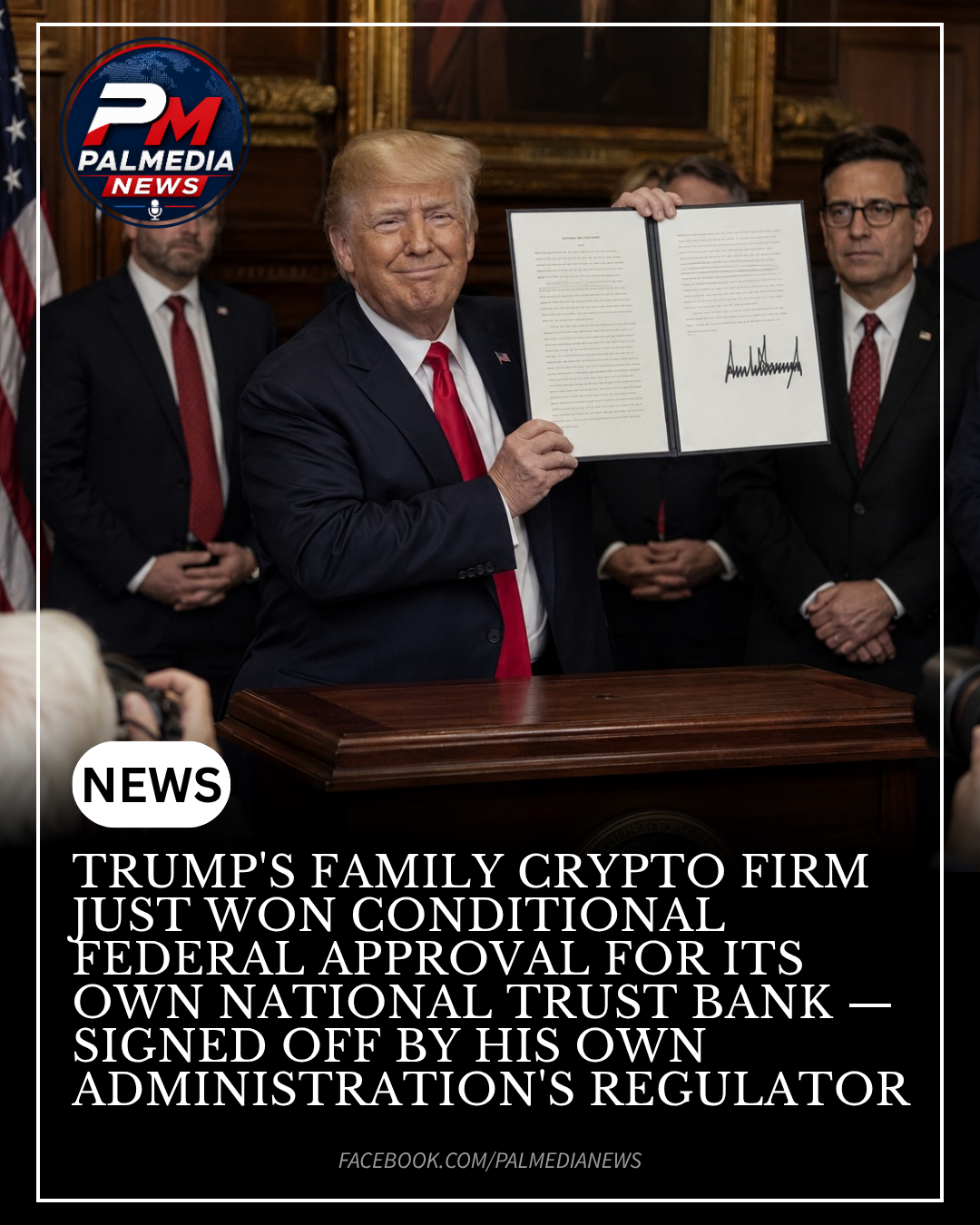
A cryptocurrency company co-founded by President Donald Trump has cleared a major regulatory hurdle on its path into the federal banking system. On Friday, the Office of the Comptroller of the Currency granted preliminary conditional approval to World Liberty Trust Company, National Association — a decision that moves a venture partly owned by the president and his family one step closer to operating as a federally chartered institution.
The approval is not final, and the charter is narrower than a conventional bank. But the significance is hard to overstate: a federal regulator housed inside the president’s own administration signed off on a bank application tied to the president’s own family business.
What the OCC Actually Approved
The Office of the Comptroller of the Currency is the federal agency that charters and supervises national banks. It sits within the Treasury Department, and its comptroller is appointed by the president.
What the OCC granted here is a national trust charter — not a full-service commercial banking license. That distinction matters. A national trust company cannot take ordinary customer deposits, it cannot offer checking or savings accounts, and it cannot make loans. What it can do is act as a fiduciary: holding, safeguarding, and administering assets on behalf of others.
For World Liberty Financial, the company sponsoring the trust, that authority is the entire point. The firm issues a dollar-pegged stablecoin called USD1 — a digital token designed to trade one-to-one with the U.S. dollar and backed by reserve assets such as short-term Treasury securities. A national trust charter would let the company issue that token and custody the reserves behind it inside a federally regulated entity, rather than depending on outside banking partners to do the job.
The Ownership Question
World Liberty Financial states on its own website that roughly 38 percent of the venture is owned by an entity affiliated with Donald J. Trump and certain members of his family. The president co-founded the company, and it has become one of the most visible pieces of the family’s expansion into digital assets.
That ownership stake is what separates this application from the others the OCC has processed this year. The agency has granted similar conditional trust charters to other cryptocurrency firms over the past several months as digital-asset companies have moved to bring their operations inside the federal regulatory perimeter. Those approvals drew industry attention but little political controversy. This one is different only in who owns the applicant.
The Conditions Still Ahead
Preliminary conditional approval is a milestone, not a finish line. Before World Liberty Trust Company can open for business, it has to satisfy a list of requirements set by the regulator. Among them: maintaining at least 20 million dollars in capital, with no less than half of that held in liquid assets that can be converted quickly.
Conditional approvals of this kind are standard practice at the OCC, and they can take months to convert into a final charter. Some applicants never clear the bar at all.
The Reaction on Capitol Hill
The response from Senate Democrats was immediate and blunt. Senator Elizabeth Warren, the ranking member of the Senate Banking Committee, called the decision “the most brazen act of self-dealing our financial system has ever seen.”
Warren and ten other Senate Democrats have introduced legislation they are calling the Ending Presidential Corruption in Banking Act. The bill would bar federal regulators from approving bank charters for institutions owned by a sitting president, his family, or other senior government officials. As of now, the measure has not passed, and it faces long odds in a Congress where Republicans control the agenda.
Defenders of the decision make a procedural argument: the application was reviewed under the same standards the agency applies to every other trust charter, and rejecting it because of who owns the company would itself be a political act. Critics respond that the standards are not the issue — the ownership is, and no set of technical criteria can resolve a conflict of interest this direct.
What This Means for Americans
For most households, nothing changes tomorrow. This is not a bank that will hold your paycheck or write your mortgage. But stablecoins have quietly become a large and growing part of the financial plumbing, and the reserves backing them are increasingly parked in the same short-term government debt that money market funds and banks rely on. Who is allowed to issue those tokens, and who supervises the people holding the collateral, is a question with real consequences.
The larger issue is one the country has not had to answer before. Federal banking regulators are supposed to operate at arm’s length from politics. When the applicant is the president’s family business and the regulator answers to the president, the arm’s length gets very short. Whether Congress decides to draw a line there is now an open question.
Stay informed on the stories that matter most. Follow Palmedia News on Facebook and bookmark palmedianews.com for breaking news and analysis.