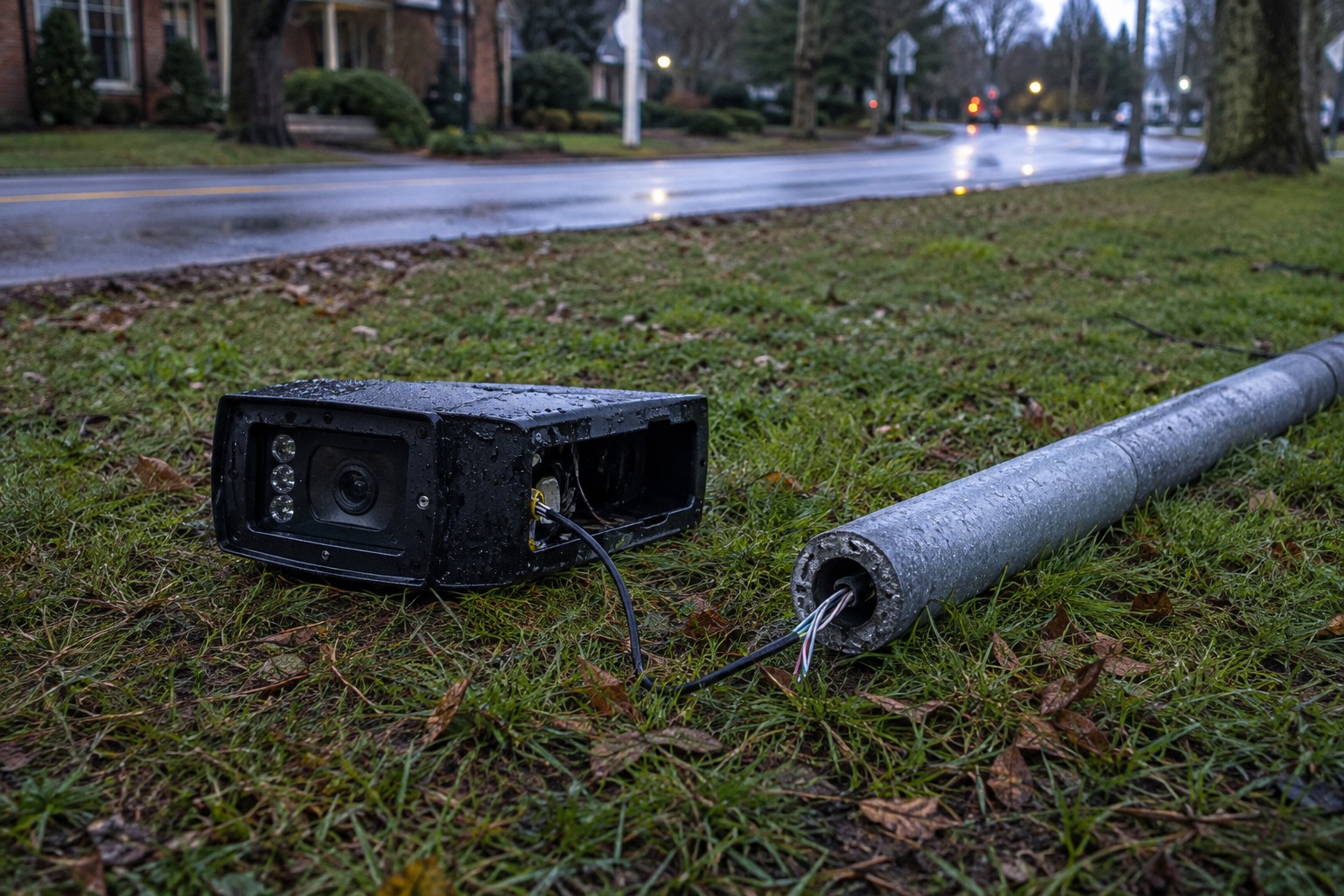
Police in a small Minnesota town are facing a mystery they cannot explain. In a single overnight stretch, every automated license-plate reader the department operates — the pole-mounted Flock cameras positioned around the community — was cut down. Not one or two. Every last one, severed from its pole and left behind by morning.
Investigators arrived to find a coordinated act of destruction and, so far, no one willing to say who was responsible. The department has opened an inquiry, but the early canvassing has produced the same answer at nearly every door: nobody saw anything, and nobody is talking.
What Flock Cameras Actually Do
Flock Safety cameras are compact, solar-powered devices that automatically photograph and log the license plate of every vehicle that passes. The system records the plate number, along with the time, location, and identifying details about the car — color, make, and distinguishing features — and stores that information in a searchable database that law enforcement agencies can query.
Over the past several years, police departments across the country have installed tens of thousands of these readers, often with little public debate. Supporters describe them as one of the most effective tools available for solving crimes, recovering stolen vehicles, and locating missing people. A single plate hit can crack a case that once would have gone cold.
A Fight Over Surveillance
That same capability is what makes the cameras a lightning rod. Critics argue the readers amount to a dragnet, silently logging the movements of every driver in a community — the overwhelming majority of whom have done nothing wrong. Civil liberties advocates have warned that the data can be pooled across jurisdictions, retained for long periods, and searched without the kind of oversight that governs other forms of surveillance.
Communities around the country have pushed back in different ways — through city council fights, public records requests, and votes to limit or remove the cameras. What happened in this Minnesota town was something else entirely: a decision, made by someone, to take every camera down in the dark and vanish.
The Investigation
Authorities are treating the incident as criminal damage to public property. Cutting down municipal equipment is a crime regardless of how anyone feels about the devices, and the department has said it intends to rebuild the network. Replacing every unit will take time and money, and until then a tool the police had come to rely on is simply gone.
But the piece investigators keep running into is the silence. In a town small enough that neighbors tend to know one another, the near-total absence of witnesses — or of anyone willing to come forward — has become its own story. Whether that reflects genuine ignorance or quiet approval is the question hanging over the case.
What This Means for Americans
The episode lands in the middle of a national conversation that most people never asked to have. Automated plate readers have spread into thousands of communities, often faster than residents realized. For some, that is a public-safety win worth defending. For others, it is a quiet erosion of the expectation that you can drive to work, church, or a doctor’s appointment without a record being made. This one town’s overnight mystery has put that tension on full display — and the reaction to it may say as much as any survey ever could.
Stay informed on the stories that matter most. Follow Palmedia News on Facebook and bookmark palmedianews.com for breaking news and analysis.