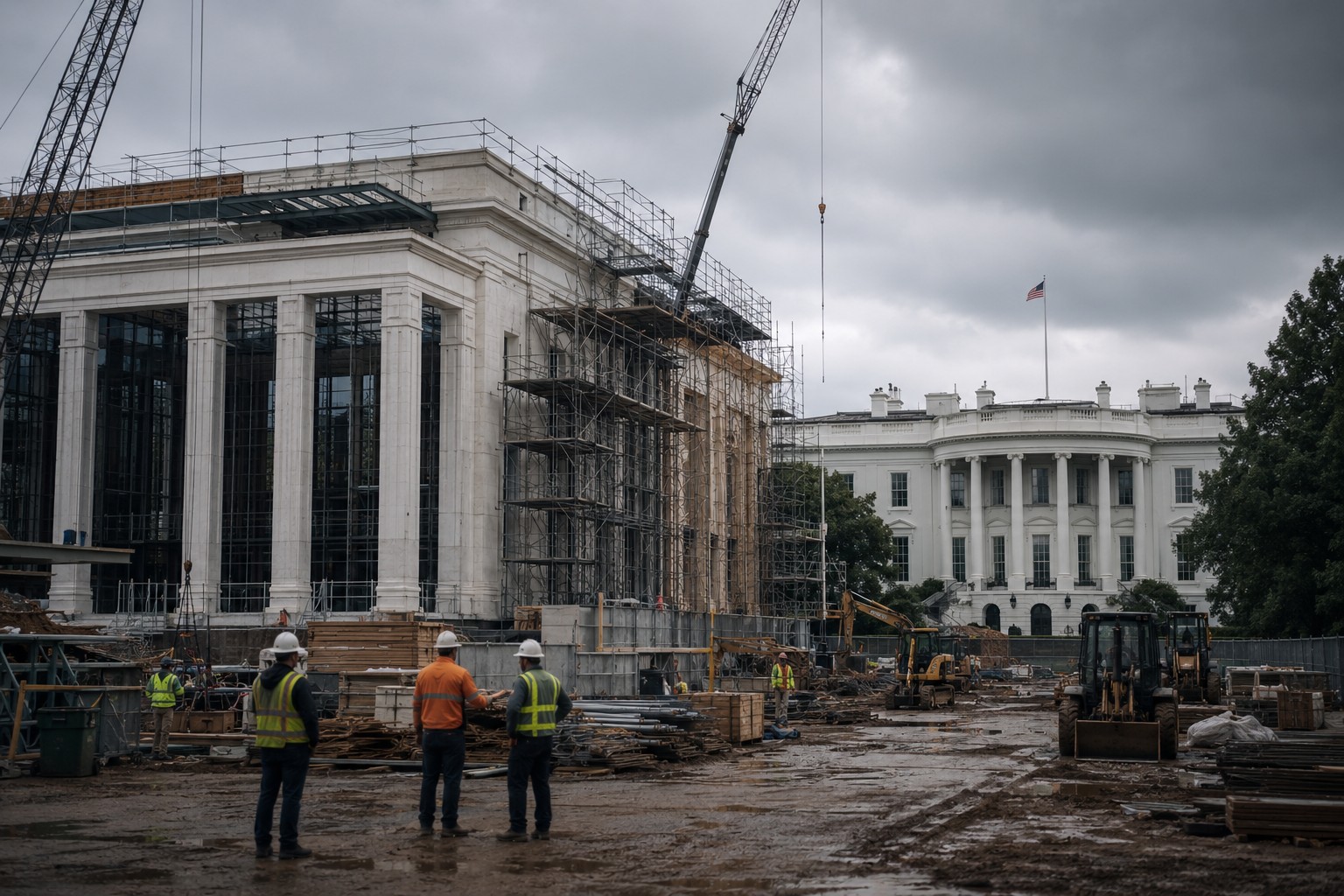
A federal appeals court has ordered construction of President Donald Trump’s $400 million White House ballroom to stop, ruling that the president cannot move forward with the sweeping project without the approval of Congress. The 2-1 decision came down on August 7 from the U.S. Court of Appeals for the District of Columbia Circuit, delivering one of the most significant checks yet on the administration’s power to remake the White House grounds.
“Whether or not a massive ballroom should be constructed is for Congress to decide,” the majority wrote, rejecting the argument that the president holds the authority to greenlight the project on his own. The ruling was stayed for two weeks to give the administration time to appeal to the Supreme Court.
How the Project Got Here
The proposed ballroom is enormous by any measure. Plans call for a 90,000-square-foot structure capable of holding up to 999 people, built on the site of the East Wing, which was demolished in the fall of 2025. The demolition itself drew immediate backlash, and just one week later the National Trust for Historic Preservation filed suit, arguing the administration had torn down a piece of American history without proper authorization.
The administration has said the ballroom would be privately funded, though it had previously asked Congress for as much as $1 billion connected to the broader project. That mix of private money and federal involvement became central to the legal fight over who ultimately controls what gets built on the White House campus.
What the Court Ordered
The ruling forces all aboveground construction to stop until Congress signs off on the project. Underground work on bunkers and security facilities is allowed to continue, a carve-out that reflects the national security functions housed beneath the complex.
The panel split along the lines of the judges who appointed them. Judges Patricia Millett, an Obama nominee, and Bradley Garcia, a Biden nominee, formed the majority. Judge Neomi Rao, a Trump nominee, dissented. The two-week stay means construction does not resume automatically; instead, the pause holds while the administration decides its next move.
Trump Responds
Trump did not hold back. He blasted the decision as “unjust” and announced he would take the fight directly to the Supreme Court, framing the ballroom in part as a matter of national security. He pointed to bomb shelters and what he described as “Top Secret Military Facilities” tied to the site as reasons the executive branch should be able to proceed.
Supporters of the project argue the president has broad authority over the White House grounds and that the ballroom would serve official functions for decades to come. Critics counter that a project of this size and cost is exactly the kind of decision the Constitution leaves to the people’s representatives in Congress, not to a single officeholder.
What This Means for Americans
At its core, this case is about a simple question with a long history: how much can a president change on his own, and where does Congress’s power begin? The White House is not just the president’s residence; it is a public building owned by the American people. The outcome could shape how future administrations approach major changes to one of the nation’s most recognizable landmarks, and how much say Congress has over the money and history involved.
For now, the cranes sit idle and the fate of the ballroom rests with the Supreme Court, which will decide whether the project can resume or whether the president must first win over a divided Congress.
Stay informed on the stories that matter most. Follow Palmedia News on Facebook and bookmark palmedianews.com for breaking news and analysis.