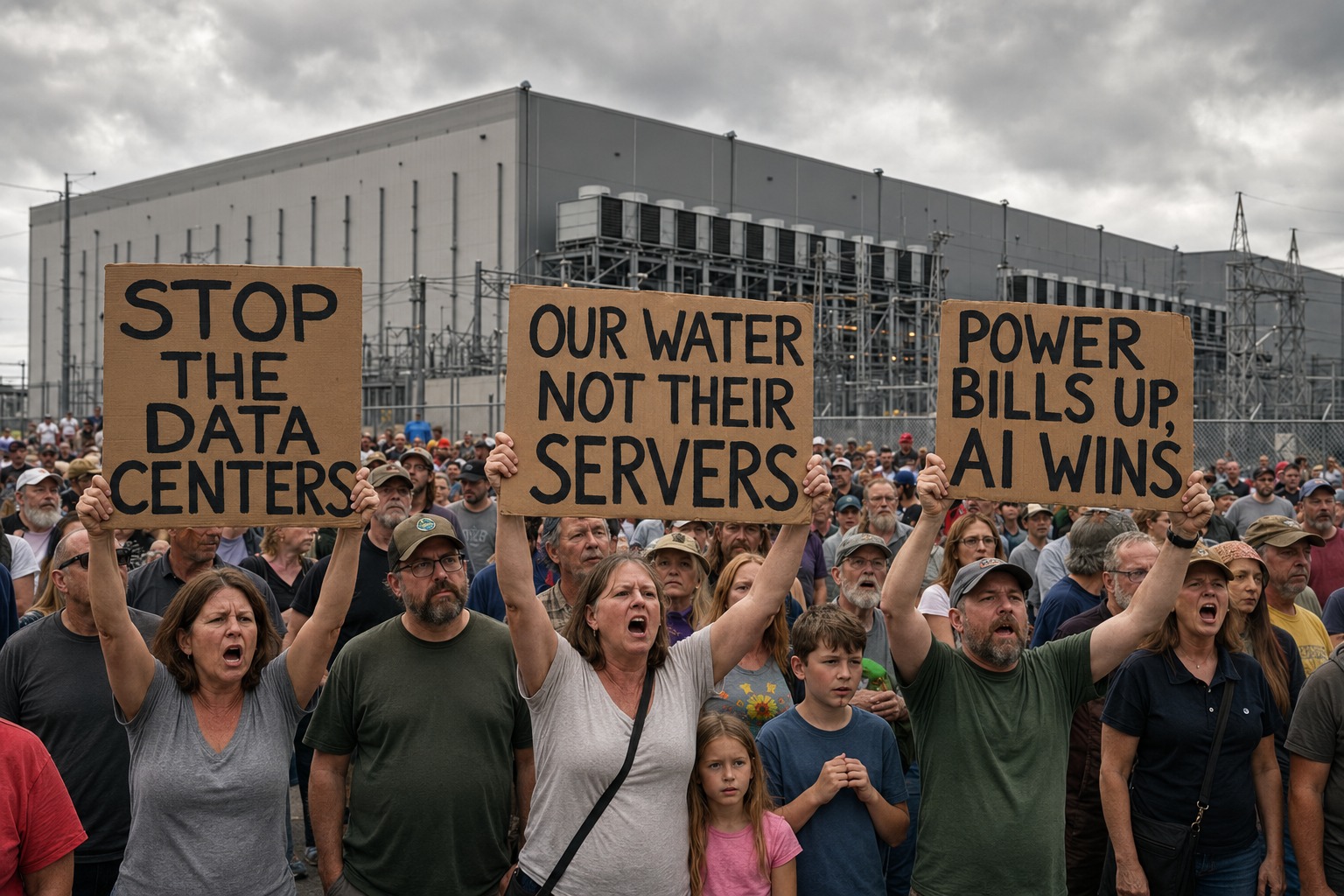
On July 18, residents in more than 50 cities across 22 states are walking out of their homes and into the streets at the same time. Their target is not a politician, a bill, or a foreign war. It is the enormous, windowless buildings going up on the edge of their towns: AI data centers.
The demonstrations, organized by the advocacy group Humans First, amount to the first coordinated national day of protest against the physical infrastructure of the artificial intelligence boom. And the grievances driving it are not abstract. They show up on utility bills and in reservoirs.
Why Data Centers Became a Kitchen-Table Issue
For most of the last decade, data centers were invisible. They were a line item in a tech company’s capital expenditure report, not something a family argued about at dinner. The AI boom changed that. Training and running large AI models requires staggering amounts of computing power, and computing power requires two things in enormous quantities: electricity and water.
The electricity draws down the same regional grids that power homes. The water cools the servers, pulled from the same municipal systems and aquifers that supply drinking water and farms. When a facility the size of several football fields lands next to a town of a few thousand people, residents feel it. They say they feel it in the hum that never stops, in the transmission towers marching across what used to be farmland, and above all in what they pay each month to keep the lights on.
What the July 18 Protests Are Demanding
Humans First has organized more than 50 demonstrations across 22 states. The stated goal is to pressure local and state officials to protect communities from the costs that come with hosting these facilities: rising utility rates, heavy water demand, noise, sweeping land-use changes, and what organizers describe as national security exposure from concentrating critical infrastructure.
Texas is the center of gravity. The state now leads the country in data center development, and it will host 11 protests on July 18, more than any other state. That is not a coincidence. Where the construction goes, the opposition follows.
What makes this movement unusual is that it does not map cleanly onto the standard political divide. The organizing group is conservative. The complaints about water tables and utility rates are being echoed by rural landowners, suburban homeowners, and environmental advocates alike. Data centers have managed to unite people who agree on very little else.
The Polling Backs Them Up
This is not a fringe position. A Gallup poll found that roughly 7 in 10 Americans oppose the construction of AI data centers in their own local area. Nearly half, 48 percent, said they strongly oppose it. That is a level of unified public opposition that most policy questions never come close to producing.
When asked why, the single most common answer was resources. Half of respondents pointed to the facilities’ impact on water, energy, farmland, and wildlife. In other words, the objection is not philosophical discomfort with artificial intelligence. It is a concrete accounting of what these buildings consume and who pays for it.
Sixty-Four Billion Dollars Already Stalled
The opposition is already leaving marks on the industry’s balance sheet. Data Center Watch, which tracks the sector, reports that roughly $64 billion worth of data center projects have been blocked or delayed amid local resistance. That is not a symbolic number. It represents zoning fights won, permits denied, and county boards that voted no.
Supporters of the buildout argue that the resistance is short-sighted. Data centers bring construction jobs, long-term tax revenue for cash-strapped counties, and the physical backbone the United States needs to stay competitive in artificial intelligence against China and other rivals. Utilities and developers have argued that new generation capacity can be built to meet demand and that many facilities are moving to closed-loop cooling that dramatically reduces water use.
Residents counter with a simpler argument: they did not sign up to subsidize someone else’s server farm. If the tax revenue arrives but the power bill doubles, they say, the deal is not a deal.
What This Means for Americans
Most Americans will never set foot inside a data center. But the fight over them is going to land on ordinary households in the most ordinary way possible: the monthly utility bill, and whether there is enough water in the reservoir come August. The AI industry’s growth has to be built somewhere, and somewhere is a real place with real neighbors. July 18 is the day those neighbors intend to make that unavoidable.
Stay informed on the stories that matter most. Follow Palmedia News on Facebook and bookmark palmedianews.com for breaking news and analysis.