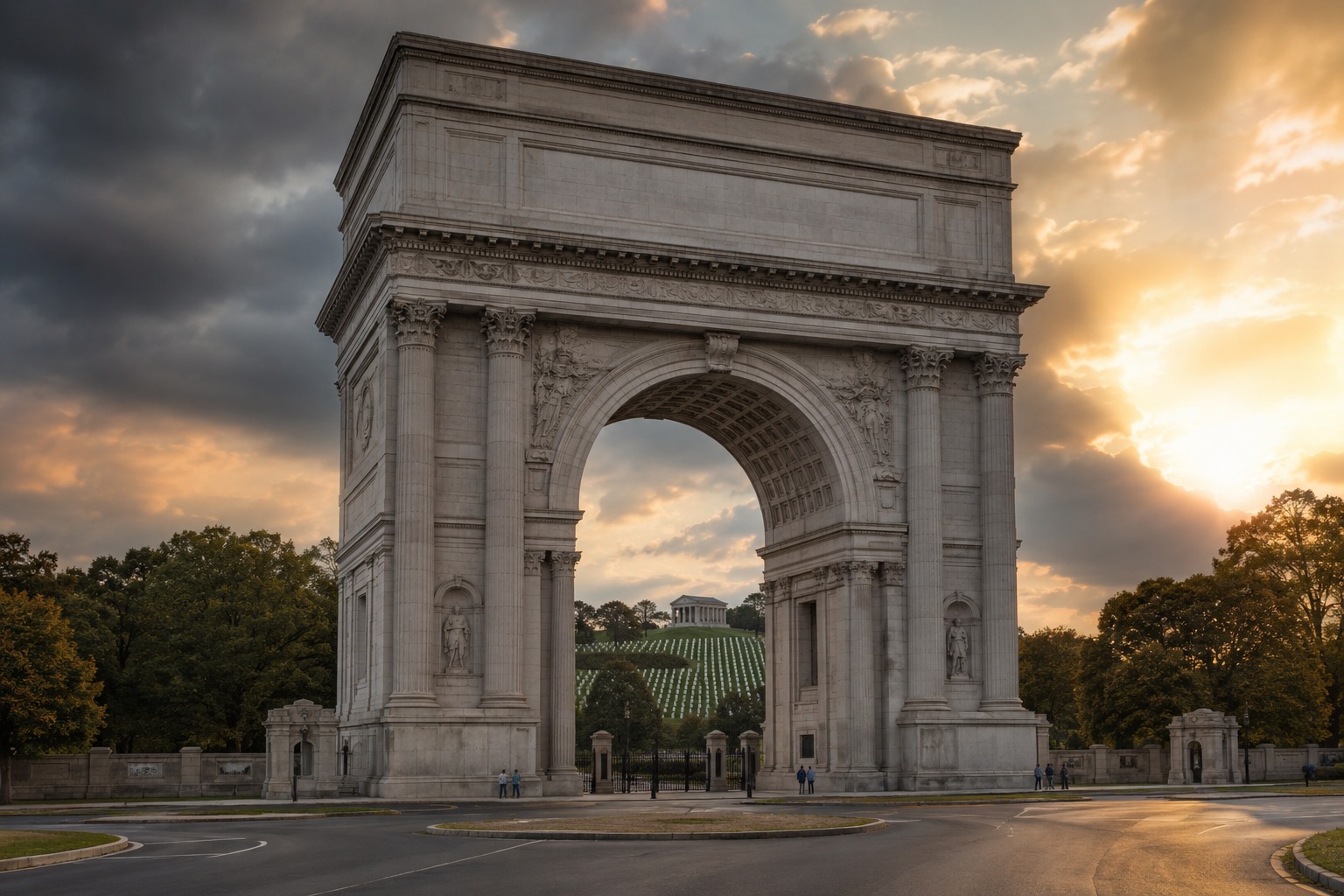
A federal commission has cleared the way for a 250-foot triumphal arch to rise at Memorial Circle, the traffic circle that sits between the Arlington Memorial Bridge and the front gates of Arlington National Cemetery. The National Capital Planning Commission voted 8-1 on July 9 to grant preliminary approval to the site and building plans, with three members voting present.
The vote came after nearly three hours of public testimony, the overwhelming majority of it opposed to the project.
What Was Approved
The commission signed off on the preliminary site and building plans only. It did not give the project a final green light. Commissioners asked for a revised design to be resubmitted, and a final approval vote could come as soon as the commission’s September meeting. Until that happens, nothing gets built.
The structure is being presented as a monument to the 250th anniversary of American independence, timed to the nation’s semiquincentennial. At 250 feet, it would stand more than twice the height of the Lincoln Memorial and rank among the tallest structures in the capital region.
Why the Location Is the Fight
Memorial Circle is not a neutral piece of ground. It sits at the end of the Arlington Memorial Bridge, on the axis that runs from the Lincoln Memorial across the Potomac to the gates of Arlington National Cemetery. That sightline was designed deliberately. The bridge and the approach were laid out as a symbol of national reunification after the Civil War, physically linking the memorial to Lincoln with the burial ground of the nation’s war dead.
Dropping a 250-foot arch into the middle of that axis is what has drawn the sharpest objections. Critics argue the structure would dominate the approach and interrupt a view that was engineered, over a century ago, to carry a specific meaning.
The Opposition
Veterans’ organizations and Gold Star families were among those who testified against the plan. Their argument was blunt: the entrance to a cemetery holding roughly 400,000 American war dead is not the place for a triumphal arch.
Several speakers pointed to the form itself. Triumphal arches, historically, are built to celebrate military victories and the leaders who won them. They are monuments to conquest. Arlington, by contrast, is a place of mourning. Opponents said placing one at the other’s gates inverts the meaning of both.
Supporters counter that a country marking 250 years of independence deserves a landmark equal to the occasion, and note that Washington has a long history of monuments that were called excessive when they were proposed and became beloved later. The Washington Monument and the Lincoln Memorial both drew criticism in their day.
Who Decides
The National Capital Planning Commission is the federal agency that reviews building plans in the Washington region. Its leadership includes appointees selected by President Trump, who has publicly championed the arch. That composition is part of why opponents view the 8-1 preliminary vote as a formality rather than a genuine test, and why they are focused on the September session.
The three “present” votes are worth noting. On a nine-member panel, three commissioners declined to endorse the plan outright without formally opposing it — a signal that support is not as unified as the headline vote count suggests.
What This Means for Americans
Monuments outlast the administrations that build them. Whatever goes up at Memorial Circle will be the first thing visitors see on their way to Arlington for the next century or more — the frame around the place where families go to bury and visit their dead. That is why a zoning vote about a traffic circle drew three hours of testimony from people with no financial stake in the outcome.
The design fight now moves to September. The question the hearing never settled is the one that will decide it: who is the arch actually for?
Stay informed on the stories that matter most. Follow Palmedia News on Facebook and bookmark palmedianews.com for breaking news and analysis.